Follow me on LinkedIn to stay updated on new posts, or reach out if you’re looking for a product manager for your team.
On a flight to Tokyo, three women sitting behind me spread across their tray tables an arsenal of guides, maps, and printed schedules. For hours they planned their trip with precision: “Breakfast at 8:00, departure at 8:30, train at 8:37, arrive at Asakusa at 9:20, walk until 10:30, subway at 10:34…” It was fascinating. And also a little terrifying. I survived thanks to the noise cancelling on my headphones.
I travel the opposite way. I buy the flight, book somewhere to sleep, and the rest is uncharted territory. I carry guides but read them like someone browsing a menu: with curiosity but without commitment. I’ve returned from cities without having visited some of their most celebrated landmarks. And I have no regrets.
Watching those women build their itinerary, I thought: what happens when they miss a train? What if they arrive at a temple that takes their breath away and want to stay an extra hour? In Japan, with its flawless infrastructure, maybe the plan survives intact. But swap Tokyo for Bangkok or Hanoi, and that schedule becomes an optimistic fiction.
This tension between exhaustive planning and improvisation — between following the map or trusting the compass — appears constantly when we build digital products. And the consequences of choosing wrong are far more serious than missing a temple.
Waterfall-style roadmaps are the corporate version of those women on the plane. Everything is planned from the start: first you gather all the requirements, then you design the complete solution, then you develop each piece in sequence, finally you test and launch. It’s a descending flow, like a waterfall, where water can never flow back up.
This model makes sense in certain contexts. If you’re building a bridge or programming the software for a pacemaker, you need that rigidity. The physics of concrete and medical regulation demand certainty.
But applying Waterfall to a young digital product is like planning every minute of a trip to a country you’ve never visited. You’re assuming you know the territory before you’ve set foot in it. That you know exactly what your users need before watching them use what you built. That the market will hold still while your team advances linearly for months.
The reality is harsher: you don’t know what you don’t know. And in digital products, what you don’t know tends to matter a great deal.
On one of those aimless walks that define my travels, I stepped into a café in Singapore to escape the heat. The place was called Rough Guys Co., and in the bathroom I found something that stopped me cold. On the mirror glass, in thick brushstrokes with dripping paint, a phrase had been written: “Direction is more important than speed.”
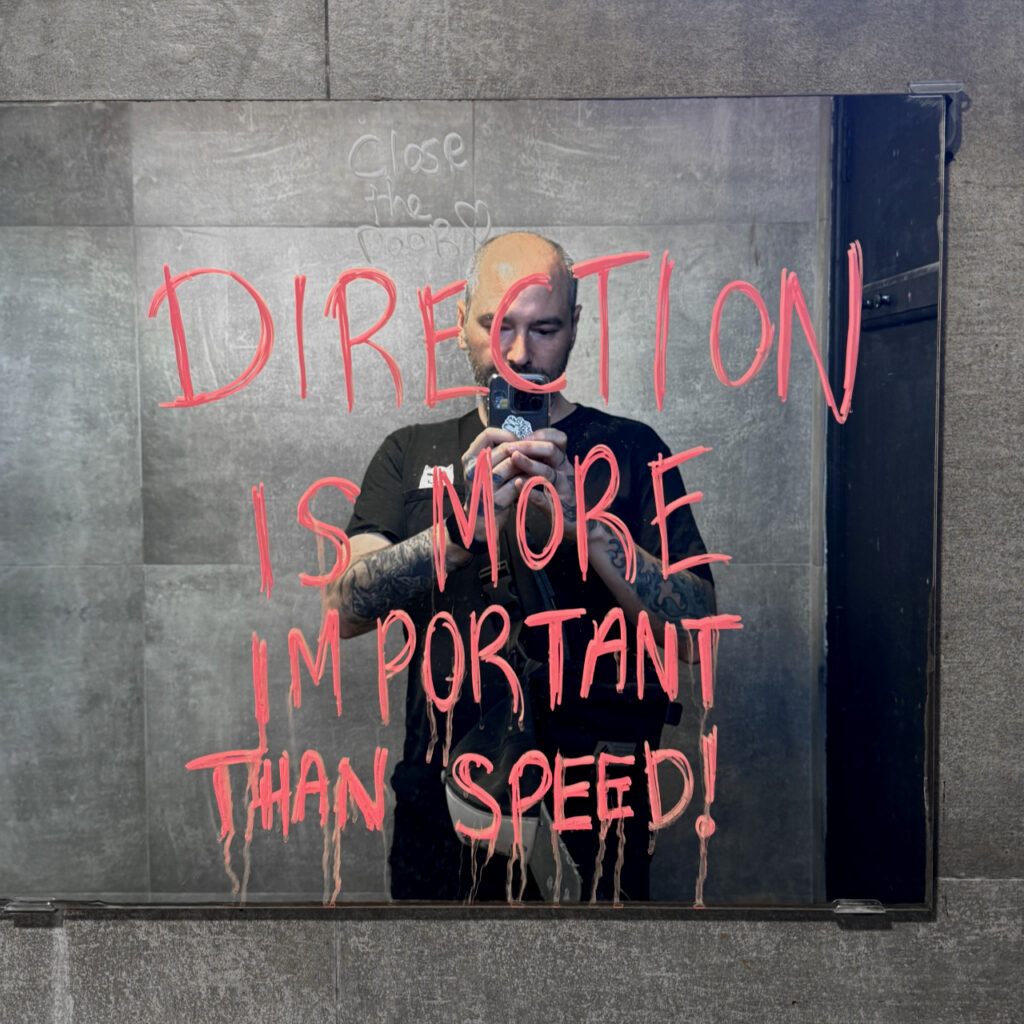
Rough Guys Co., Singapore, 2024.
In startups, in companies searching for product-market fit, in teams still discovering what problem they’re actually solving, speed without direction is just chaotic movement. You can ship features every week, iterate compulsively, generate constant activity… and still be lost. Or worse: advance confidently toward the wrong place.
Direction doesn’t come from a master plan drawn up in January for the entire year. It comes from signals: patterns in how people use (or don’t use) what you build, conversations with users that reveal frustrations you never imagined, movements in the competition… These signals almost always converge on a simple premise: build the best possible product for the people who need it.
That’s the compass. Not a schedule. Not a roadmap with fixed dates. A clear direction that can adjust when the terrain changes.
But there’s no universal answer. Planning versus flexibility isn’t a war with an absolute winner. It’s a question whose answer changes depending on where you’re standing.
If you have a mature product with millions of users, you need some structure. You can’t improvise completely when every decision affects complex ecosystems. If you’re at a small B2B company and a client representing 40% of your revenue requests something specific, your theoretical roadmap instantly becomes worthless. If you’re running a startup in search of product-market fit and you cling to a six-month plan because “we already decided this at the kickoff,” you’re choosing rigidity over learning.
You need to know what you need at each moment. Structure to coordinate complexity? Flexibility to discover what works? Speed to stay alive? Direction so that speed isn’t wasted?
I don’t believe in being fast for the sake of being fast. The “speed wins” culture sounds exciting, but it can also mean burned-out teams, fragile code, and users confused by contradictory pivots.
I believe in rhythm. A sustainable pulse where the team can learn, build, learn again. Where direction is adjusted based on decisions made with information in hand. Where moving forward doesn’t necessarily mean adding, but sometimes simplifying, removing, refining.
And there’s something else: the distance between having a hypothesis and testing it with real users has compressed to nearly nothing. Tools like Claude Code and vibe coding are blurring the boundaries between roles that once demanded absolute specialization. A small, multidisciplinary team can now run the full cycle — design, prototype, implement, test — in days, not months. Sprints compress. What determines how long things take is no longer how much time you calculated you’d need, but how much time you decide to invest before validating whether you’re heading in the right direction.
This doesn’t make Waterfall obsolete in every context. But it does disintegrate one of its fundamental pillars: the idea that changing direction is so costly that it’s better to plan everything from the start. When pivoting costs a week instead of three months, exhaustive planning stops being prudence and becomes unnecessary rigidity.
Traveling without a rigid plan doesn’t mean wandering without purpose. It means keeping the intention clear — “I want to understand this city” — while remaining open to letting the city teach you how. In product, it works the same way. You know where you’re going — creating value for specific users — but how you get there emerges from contact with reality, not from a document written months earlier by someone who never spoke to a real customer.
I’m sure the three women on the plane probably had a wonderful trip. Their plan worked because they chose the right context: a country where infrastructure doesn’t fail, where schedules are sacred. Their approach was coherent with the terrain.
My improvisation works because I read the terrain as I move through it. I let the city teach me its rhythms, let the streets show me which way to go, let a casual conversation with a vendor reveal a neighborhood no guide book mentions. It’s not aimless wandering: it’s following the signals that only appear when you’re present, attentive, available to what the place has to say.
In product, the question isn’t which philosophy is better. It’s which one serves the moment you’re living. And having the honesty to recognize when you need to switch from one to the other.
Because the only thing worse than a rigid plan in uncertain territory is chaotic improvisation in a situation that requires coordination. And the only thing worse than both is not knowing which one you’re using or why.
The compass tells you where. The clock tells you when. Knowing which one to look at in each moment: that’s where the real journey lies.
–
Written with the help of an AI assistant for documentation, trained on my previous texts.