CASE Study
Vidiv
From Technical Experiment to Scalable Platform in one year
Vidiv wasn’t taking off: from its original product, a massive online events platform, it pivoted to an online teaching platform that also failed to find product-market fit. However, leveraging accumulated knowledge about WebRTC applied to video calls, the technical team decided to build a technical proof of concept consisting of an AI-based voice conversational agent. It worked, some clients showed interest, but it was clearly a technical experiment with no clear commercial future. The first 6 months I helped shape it from my position as designer at Visual MS and, by mid-2025, I was put in charge of product and operations.
Summary
Context: Startup pivoting to AI-based voice conversational agents
My role: Product and operations lead
Product team: Miguel (full-stack developer), Iria (design)
Result: From unstable experiment to INNDAT 2025 winner with ~20 clients (Moeve, Lexidy, Transpaís)
The Real Problem
State in June 2025:
The voice agent worked but everything started with a very basic interface and each implementation required manual intervention. To relieve pressure on the team, a strategy was implemented that consisted of delegating agent prompting and integrations to partners, but there were no clear processes in that regard. There was also no control over billing or profit margins from services they offered. Clients were interested but features needed to be expanded and several processes automated.
The question: Is this a business or just a technical experiment?
The Solution
Transform the experiment into a platform where partners could autonomously create and manage voice agents with robust integrations.
Strategic differentiator: «We don’t make chatbots. We create agents that provide value through integrations with real systems, committed to safe, ethical, and responsible use of artificial intelligence.»
My Role
Product and operations lead
Roadmap and prioritization | Technical team coordination | Partner operations restructuring | Billing control and service-derived profit margins
What We Built
Consolidation: Turning It into a Product
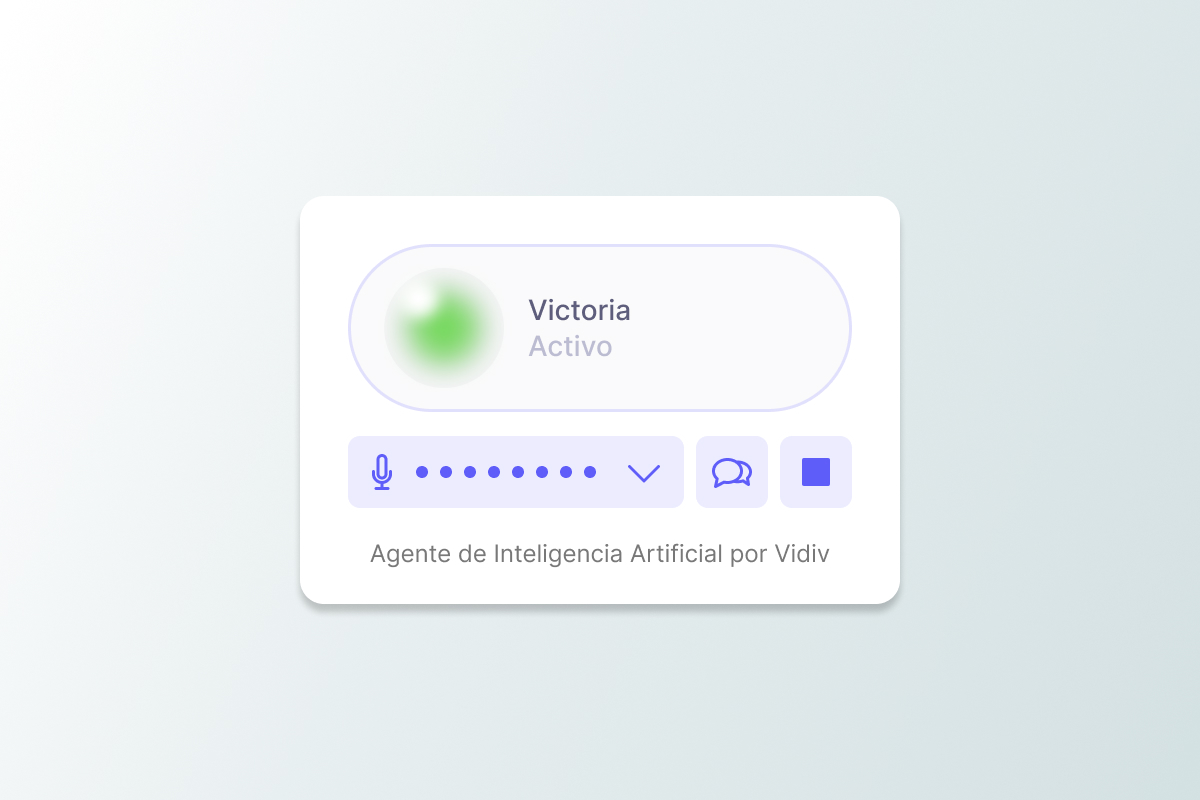
First was consolidating what we had. The technical experiment worked — the team already had solid WebRTC experience from the online events era — but everything was manual and fragmented.
We consolidated the database to automate processes that until then required manual intervention. But the most important work was redefining the interface. The engineers had built it functional but it required many design adjustments: the visual experience was poor and usability left much to be desired.
The most significant change was transforming it from audio-only to a multimodal experience where you could switch from voice to text without friction. This required completely rethinking the interface.
Additionally, we had a duplication problem: two separate interfaces existed — an iframe for web integration and a fullscreen version. Each change required redesigning and implementing in both. We converted them into a single, reusable component, reducing design and frontend work by half.
We added real-time conversation flow monitoring to understand what was happening in production.
In parallel, we restructured how partners operated: defined clear billing processes, established profit control, and created spaces that allowed us to control the integrations they performed.
Autonomy: Eliminating the Bottleneck
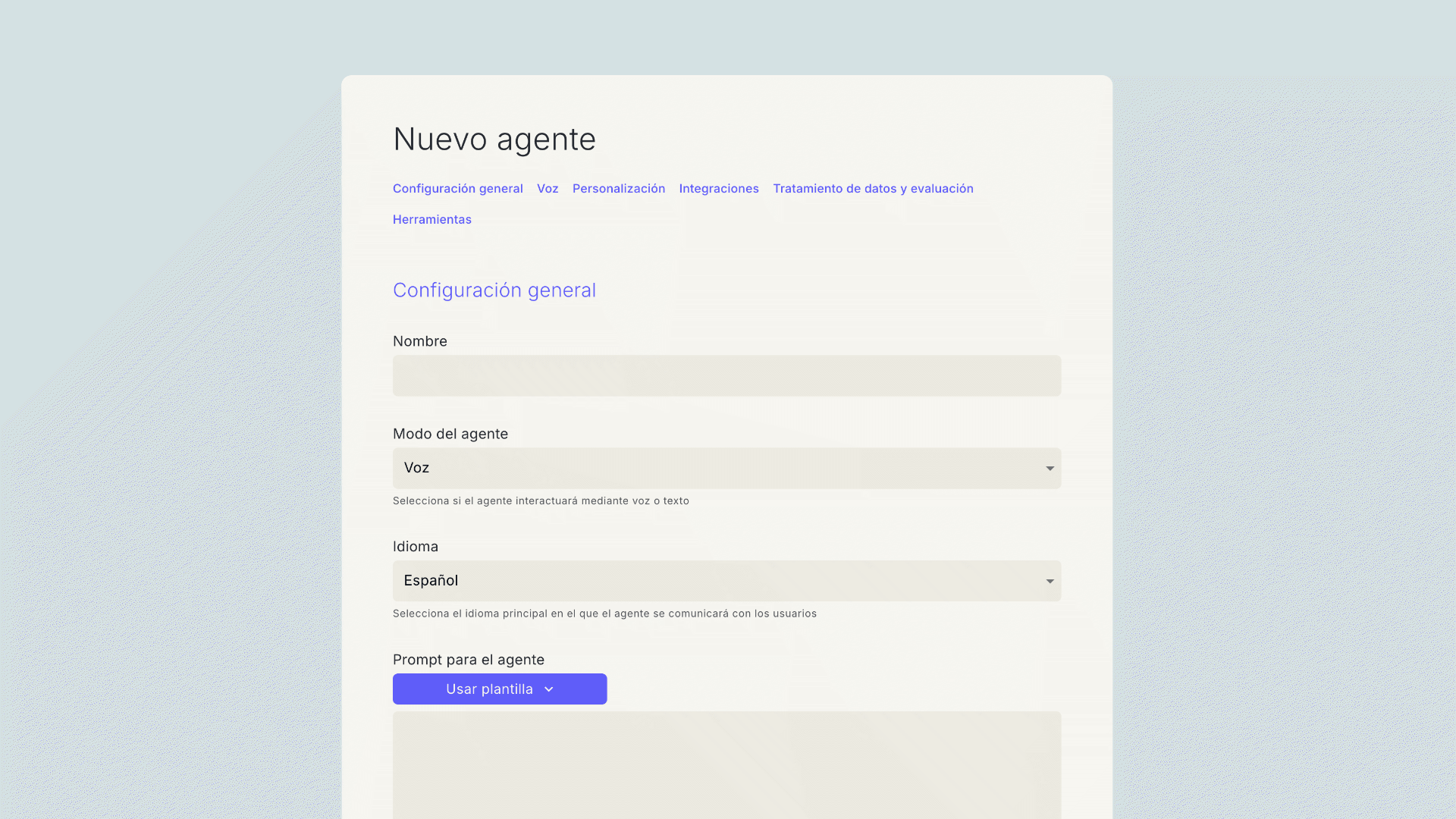
We built a complete private area where partners and clients could manage agents without depending on us for every small change. This included autonomous agent creation and configuration, full widget customization, prompt editor with advanced controls (Temperature, Top P), and voice and AI model management.
For clients we developed an analytics panel: real-time consumption dashboard, individual agent analysis, automatic detection of recurring themes and FAQs, conversation transcripts, improvement opportunity identification, alerts at 80% consumption, and data export.

Differentiation: Integrations as Competitive Advantage
We bet on connecting with real systems. We implemented webhooks (pre and post conversation), MCP (Model Context Protocol) integration, user data pre-loading before starting conversation, contact origin URL identification, and intelligent call routing based on configurable conditions.
This enabled differentiated use cases: agents that access the CRM and know the customer’s history before greeting them, already logged-in users whose agent automatically has their data, personalized catalogs based on profile, escalation to human only when specific conditions are met.
We integrated 10+ AI models (GPT-4o, GPT-5, GPT-5.1, GPT-5-nano, Claude 3.7/4/4.5, Gemini, Amazon Bedrock, Deepseek R1, Llama 3) to provide cost/quality optimization flexibility. We added support for 50+ languages including Spanish co-official languages, expressive voices, voice cloning, and verbosity control.
On UX: unified chat + voice interface, real-time transcription, automated outbound calls, links with preview, widget that adapts to browser language, suggested questions to start conversation, and automatic call termination.
We anticipated the European AI Act by implementing «AI Agent by Vidiv» labeling plus GDPR consent management.
Go-to-market: Closing the Sales Cycle
Finally, we needed prospects to see the product working quickly. We built a prompt generator for personalized demos, implemented Spanish national phone numbers…
We went from «some interested clients» to a replicable sales process at an international level.
Results
98 releases in 6 months
~20 clients (Moeve, Transpaís, Lexidy, among others)
INNDAT 2025 winner (startup category)
3 Partners managing ~20 clients
Transformation
The transformation was complete. We went from a technical experiment with no clear commercial future to a viable product with defined strategy. From requiring manual intervention for each client to a self-service platform where partners operated autonomously. From an architecture dependent on manual processes to an automatic system. From partners operating without control to clear billing and profit processes. And from diffuse positioning to a clear message: «agents that provide value through robust integrations.»
Critical Decisions
1. Consolidate before shining
The first 2 months were focused on polishing the technical proof to turn it into something functional at both technical and user experience levels.
2. Autonomy as priority
The private area for partners to create agents wasn’t the flashiest feature, but it allowed us to scale. The more possibilities we gave partners, the better the agents became.
3. Integrations to provide value
We always considered integrations the critical point for delivering value to clients. A voice conversational agent, however well it works, must offer something more than the ability to surprise. If it can’t integrate with other systems, it becomes a toy.
4. Multi-model
10+ models added complexity, but provided flexibility and reduced dependence on a single provider. Important when LLMs constantly release new versions, affecting agent behavior.
5. Anticipatory compliance
We implemented labels to be transparent and comply with the AI Act. It became a sales argument with corporations.
6. Partner operations first
Billing control before scaling was fundamental, without it we wouldn’t obtain profits.
Key Learnings
Transforming Experiments into Products
- Demo ≠ production. The difference: processes, monitoring, boring architecture
- Operations is product. Without partner billing control, there’s no scalable business
Voice
- Latency = UX. 500ms feels eternal in voice conversation
- Multimodal > voice only. Users want to choose channel based on context
Platforms
- Partners need quick success. First failed client = abandonment
- Analytics > flashy features. Adherence came from actionable data
Differentiation
- «Another voice agent» is not positioning
- Integrations (webhooks, MCP) were the real differentiator
- Clients wanted «agent that accesses my CRM,» not «agent that speaks nicely»
AI Models
- Model selection = product decision (impacts UX, costs, differentiation)
Takeaway
From technical experiment with no clear future to INNDAT 2025 winning platform with ~20 clients and autonomous partner network in 6 months.
Success didn’t come from voice technology (it already existed). It came from converting fragile prototype into product with solid processes, autonomy tools, and integrations that provided real value.
The biggest learning: Technical experiments are entertaining, but they’re not businesses. Converting one into the other requires months of unglamorous work: architecture, processes, operations. That boring work is what separates a demo from a product.
Status: INNDAT 2025 Winner | ~20 clients | Autonomous partner network
–
Email me if you want to chat about this case.
–