Post content
Warning: spoilers from the video game Cyberpunk 2077.
I just got a call from Judy. She's having problems with the Arasaka corporation again. And, as always, I seem to be the easy solution. As if taking out a dozen corpos armed to the teeth was... "easy."
I calmly walk over to the fridge while deciding what steps to take. My refrigerator is colder than the chrome covering the corpos' skin. All I manage to do is feel disappointed in myself for not having anything to eat. Just a miserable beer... not enough to get Johnny Silverhand out of my head. Even for a few minutes.
I open the can, take a sip and there he is, next to me, again. With a cigarette in his hand, as always.
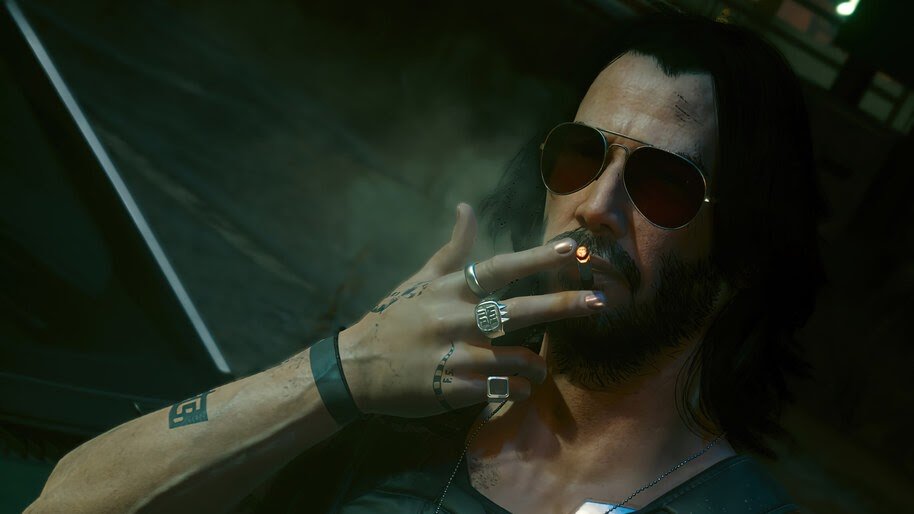
I ignore him, finish the drink and throw the can in the trash. What the hell, I'll have to replace beer with corpo blood. I'm sure Judy will thank me with some cyberware implant.
I grab my jacket, the revolver I stole from Kerry and leave the building.
I see my favorite bike in the distance, the Yaiba Kusanagi CT-3X. As it approaches me, Johnny gets into my head again. This time I have to listen to one of his war stories from when he had a band: the fans, the drugs, the violence, his fight against the megacorporations...
From what he tells me, it doesn't seem like the world has changed much... except for the nuclear bomb that devastated the city 30 years ago. The bomb that Johnny set and is so proud of.
I get on the bike and accelerate. His voice finally fades. He doesn't usually talk to me while I'm driving, maybe he's afraid I'll kill myself on the road and disappear with me. After all, he ended up in my head because of a car accident.
I park calmly in front of the Arasaka offices in the city center. I don't like subtleties, so I draw my gun while walking through the main entrance and start shooting before the door closes behind me.
The next 15 minutes are a slaughter with Johnny cheering me on like one of his groupies would when seeing him on stage.
When I'm the last one standing, the hard work begins: searching the corpses for the neuros that Judy asked for.
They really are the only valuable thing I find, except for a cigarette case with some gold details.
As soon as I have it in my hand Johnny appears again... to try to convince me to smoke a cigarette.
I doubt his intentions. There are few days left before he completely controls my brain and I have the feeling that if I give in to his habits my lifetime will be reduced. Just like the lit cigarette he carries in his hand.
Johnny Silverhand, played by Keanu Reeves, is one of the main characters in the video game Cyberpunk 2077.
Silverhand is a rock legend who rises up against the megacorporations that dominate Night City, the city where the game takes place. His death comes after setting a nuclear bomb in one of the Arasaka corporation buildings. After a brutal fight with Adam Smasher he receives a lethal blow. It is at that moment when they transfer his consciousness to a chip. Many years later, V, the game's protagonist, has a car accident that brings him to the brink of death. It is in the brief instant before dying when they implant the chip containing Silverhand's personality.
Because of this, the protagonist's mind and control of the body are progressively eliminated to give control to Johnny Silverhand. The player's main objective is to get the chip removed before their personality is completely replaced. And, therefore, their consciousness dies.
The chip is the key to immortality, as it allows transferring a personality between different bodies.
It's curious how Keanu Reeves has gone from playing Johnny Mnemonic, who was dedicated to transporting information on a chip lodged in his brain, to playing Johnny Silverhand, who is information lodged in V's brain.
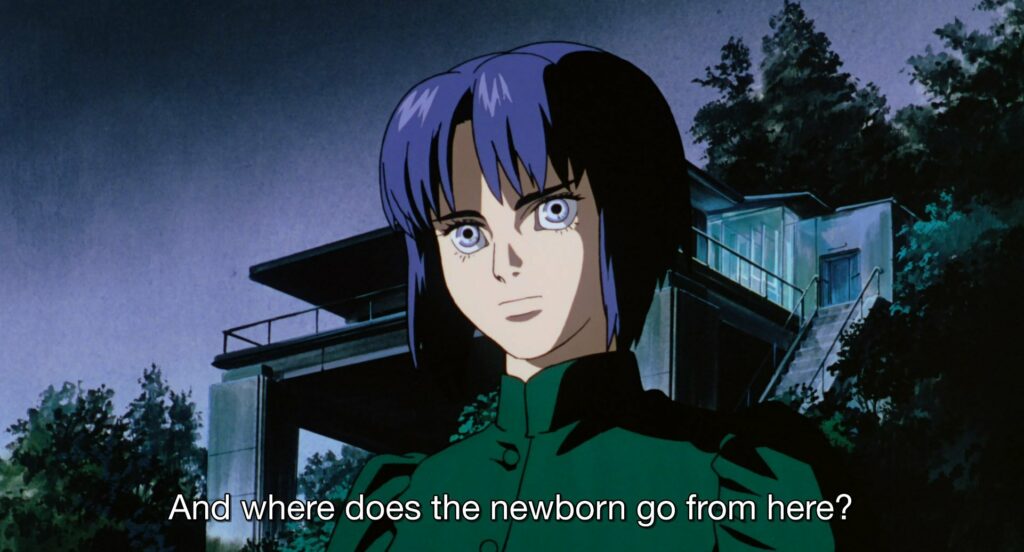
This theme, called "mind uploading," is recurrent in science fiction. We can find references in many books, movies and comics. For example: the classic Neuromancer, The Lawnmower Man, Tron, Altered Carbon, Alita Battle Angel, Chappie, Black Mirror, Ghost in the Shell...
The world of Cyberpunk 2077 is enormous both in extension and content. It's full of things to do and many missions to complete. Players take an average of 60 hours to finish it, but if you intend to complete everything you can spend about 100 hours. Additionally, V is highly customizable and has hundreds of weapons and cyberware to modify their body and expand their abilities. On the other hand, to move around such a large city you have multiple cars and motorcycles to choose from... All these characteristics are what you expect to find in a video game with a production cost of 313 million dollars.
But faced with all these excesses there is one thing that is scarce: the time your character has left to live.
And the game's designers make sure you're aware of this in different ways. Some obvious, like a counter that indicates the percentage of deterioration of your personality.
And others much more subtle.
What really shapes your sense of time are the narrative resources that the writers handle masterfully. They make it clear from the beginning that your days are numbered and use Johnny Silverhand's constant appearances to remind you that there's little time left before your consciousness dies. This way the pressure increases, to the point where you distrust whether accepting to smoke a cigarette will make your time run out faster.
The design of time's passage thus becomes one of the fundamental aspects when defining the gaming experience.
And to design it we need to understand it, what is time?
"Time is only a measure of change" or "There is a time that passes even when nothing changes"?
Do we follow Aristotle or Newton?
Or do we agree with both like Einstein did?
Only in this case the temporal field would not be affected by the electromagnetic or gravitational field, but by the script's needs.
Even, sometimes, power is given to the player to decide the speed at which it passes.
Additionally, there's a layer that adds complexity: in reality the player lives in two temporal spaces. On one hand they immerse themselves in the game's time, a virtual time. On the other, they continue experiencing the time in which they exist in the physical world. And both pass at different speeds. Furthermore, if the game is well designed, the player will enter a flow state, seeing how their perception of time is altered, feeling how its speed fluctuates.
But, in Cyberpunk 2077, the direct consequence of time scarcity is the generation of a tremendous sense of urgency. This causes the player to focus on the main story and make decisions more quickly, less thoughtfully, thinking in the short term... often wrong decisions.
And this is because, when we feel under pressure, we filter information, causing our situational awareness to decrease.
Irem Gokce, from the University of Michigan explains it as follows:
"Time pressure is also a factor that undermines creativity and performance. First, decisions made under pressure tend to be wrong. People speed up when gathering information. This causes them to 'filter' part of that information and omit some parts, which can lead to less understanding and learning. Shortening the time of the decision-making process to add pressure leads to decreased performance."
There are studies and theories that explain how people seek balance between urgency and error when making decisions. This balance is called "speed-accuracy tradeoff": the compromise between speed and precision, which is nothing more than deciding whether to respond quickly and poorly or take your time to do it well. And what determines that balance is the amount of information we need to make a decision.
Will a similar effect occur in people who alter the playback speed of movies or YouTube videos?
But scarcity reaches many more things than time. It's social psychology that is responsible for studying how humans face it, the way people manage their needs and desires in situations where resources are limited.
For example, how we give much more value to something scarce than to something abundant. Diamonds versus stones. But this scarcity is sometimes deliberate to turn an object into a more desirable item. Something very common in the luxury market.
In addition to these obvious effects, psychologist Robert Cialdini studies how the effects of scarcity affect the frontal lobe of the brain, which is responsible for decision making. These alterations modify our way of thinking and feeling and introduce biases in our decision making. Moreover, when we don't have enough resources our intellectual capacity decreases.
Eldar Shafir, professor of psychology at Princeton University, explains it very well:
"This scarcity mindset consumes 'mental bandwidth,' that is, the brain capacity that would otherwise be devoted to less pressing concerns, to planning for the future and solving problems. This deprivation can lead to a life absorbed by worries that impose continuous cognitive deficits and reinforce counterproductive actions."
But scarcity is not always a burden, but sometimes it's the trigger someone needs to develop creative solutions to face it; to care for, fix and protect unique objects... scarce ones; or to extend the useful life of food.
Think about the lines that serve to break chocolate bars. They come from World War I. Faced with scarcity, a way was designed for soldiers to give themselves a small treat and a calorie boost. Being able to break it easily into portions helped them control their consumption.
Or the Cuban mechanics who have been fixing 50-year-old cars... without access to spare parts since Kennedy blocked trade with the country at the beginning of the revolution.
Or cooking techniques like curing, pickling, smoking... which are just another way to face periods of scarcity.
Or the movies of the 80s and 90s, which had to limit their script so they could fit into the 90 minutes duration of a VHS tape.
How do you feel when you finish a chapter of a series and the counter appears warning you that the next one starts in 5 seconds? How long does it take you to decide what to watch faced with the enormous amount of content that Netflix puts at your disposal?
Scarcity, abundance... what's the best way to distribute resources when designing a digital product?
If you've made it this far, thank you for dedicating your time to me.
Follow me on LinkedIn to stay updated on new publications.
References:
https://www.apa.org/monitor/2014/02/scarcity
https://www.invisionapp.com/inside-design/design-for-urgency
https://cyberpunk.fandom.com/wiki/Johnny_Silverhand
The Order of Time, by Carlo Rovelli
https://en.wikipedia.org/wiki/Scarcity_(social_psychology)
https://en.wikipedia.org/wiki/Robert_Cialdini
https://en.wikipedia.org/wiki/Military_chocolate_(United_States)
https://social.shorthand.com/cadyvoge/jgYcFIm58oe/mechanics-of-cuba
https://en.wikipedia.org/wiki/Artificial_scarcity
https://en.wikipedia.org/wiki/Mind_uploading_in_fiction
https://link.springer.com/article/10.3758/s13421-017-0718-z
https://en.wikipedia.org/wiki/Cyberpunk_2077
https://uxplanet.org/how-to-design-for-urgency-and-scarcity-ccbd8a4e7a4b
https://designing-scarcity.hetnieuweinstituut.nl/en
https://link.springer.com/article/10.3758/s13421-017-0718-z#Sec9
https://www.wired.com/video/watch/theoretical-physicist-explains-time-in-5-levels-of-difficulty