Post content
Years ago, when I was freelance, I worked for one of the largest canning companies in Europe and the world.
The pace was frenetic. I spent several years working directly with the marketing department, surrounded by wonderful people and top-level professionals. My main job consisted of designing canned goods and, especially, preparing files for production. Something that, a priori, doesn't sound particularly glamorous—unless you call it packaging design—but that personally gave me deep satisfaction.
It wasn't just about work quality, which was also important, but about the scale of it. I prepared cans from white label to gourmet line, for Spain, Portugal, Morocco, Finland, Norway, Denmark, Germany, France, Italy, United Kingdom... Varieties and varieties of mussels, small sardines, scallops, razor clams, tuna, light tuna, albacore... And also pet food packaging, a world apart.
When I finally stopped being freelance, I looked back and wondered: how many cans will I have prepared? I pulled out the hard drive and started reviewing files. In total, 749. Counting conservatively, those had made it to market. They would probably reach a thousand if I added discarded proposals and branding experiments that never saw the light.
Seven hundred forty-nine cans. The number condensed years of work into a precise and verifiable figure. And with that figure came a more interesting question: what did I really learn from all of that?
The answer, curiously, has little to do with canned goods and a lot to do with how we build anything at scale, including digital products.
The law matters. In packaging, legislation establishes minimum requirements for font size. Not in terms of 12 or 14 points—which would give rise to creative interpretations—but in tenths of millimeters. Take a can from your pantry and measure the lowercase "x" in the ingredients list or nutritional values. If it measures less than 1.2 millimeters, you can technically report the manufacturer.
The same happens in the digital world. GDPR is not a suggestion. The AI Act is coming. ISO 27001 matters if you handle sensitive data. You can ignore these regulations for a while, but eventually reality catches up with you, and the consequences are more costly than having done it right from the beginning.
Profit margin matters. In packaging, the decision between using four or five inks can have a tremendous impact on cost when you multiply by millions of units. An additional ink translates directly into cents that accumulate until they become thousands of euros.
In digital products, choosing a more powerful large language model versus a more efficient one can multiply your operating costs. At scale, these apparently technical decisions are business decisions.
Align with your target audience. If you want to sell cheap, you must look cheap. If you want to sell expensive, you must look expensive. And this is independent of what it costs to manufacture the product. It sounds obvious when you say it out loud, but it constantly escapes us, especially those of us with design training. We have a tendency towards "excellence," towards doing things "right." But "right" is relative to context. We'll see this in the next point.
A supermarket white label doesn't need sophisticated design. It needs to convey functionality and price. High-end packaging calls for gold stamping and UV coating to look more expensive. Honesty, in design, sometimes means looking exactly as "ordinary" as you are.
Quality perception is relative. Imagine the same product but with different packaging. One with traditional design, maritime, almost nostalgic. Another with modern aesthetics, clean lines, high-end photography. Which will be better? It depends on who you ask. Both are paying for perceptions, not facts. Quality, to a large extent, exists in the mind of whoever evaluates it.
Craft matters. Print files have to be impeccably executed. A poorly prepared file—with colors in RGB instead of CMYK, with insufficient resolutions, with unvectorized fonts—can stop a complete production line. This is not aesthetic perfectionism. It's technical rigor. It's understanding that your work exists within a larger system, and that system has specific, non-negotiable requirements.
Localization matters. In France you don't need to prominently mark gluten since there's sufficient culture and awareness. In other markets, the halal seal is indispensable. Designing packaging for different countries involves challenges. It means understanding what matters in each context, what is visible and what is invisible. In digital products, true localization goes beyond language. It implies recognizing that your product is not universal, but contextual.
Communication matters. If you have a promotion of six cans for the price of five, it's worthless if you don't communicate it clearly. And sometimes, many times, you have to shout it. Literally: increase font size, use bright colors, break the elegance of your design to make sure the message gets through. White space doesn't sell promotions in a supermarket where consumers spend three seconds in front of your product.
Quick decisions matter. Sometimes it's more important that something ships, even if it doesn't ship perfect. I've maltreated typography in ways that would make other designers throw up their hands. All so they would fit in a flap of a few centimeters. I've seen good designs replaced by sufficient designs because the good ones arrived late. In digital products, this translates to shipping versus eternal iteration. Perfect is the enemy of done.
Material matters. It's not the same to prepare a design for cardboard as for can as for plastic. Each material has its own technical limitations, its own expressive possibilities. You must adapt to the material, not force it. In software, this is equivalent to respecting the capabilities and limitations of your tech stack. The material—the language, the framework, the infrastructure—has its own nature. Working with that nature is more effective than fighting against it.
–
One last reflection: pet packaging. When the product is bought for an animal (or a person) you love, you're willing to pay more. Much more. Economic logic breaks when affection comes into play.
This tells us something fundamental about value. It's not rational. It's not objective. It's emotional, relational, deeply human.
–
Seven hundred forty-nine cans.
Each one a small exercise in constraints, in negotiation between the ideal and the possible, between the beautiful and the functional. In the end, preparing files for production turns out to be a strangely precise metaphor for building anything at scale. Mastery doesn't consist of ignoring constraints, but of creating within them.
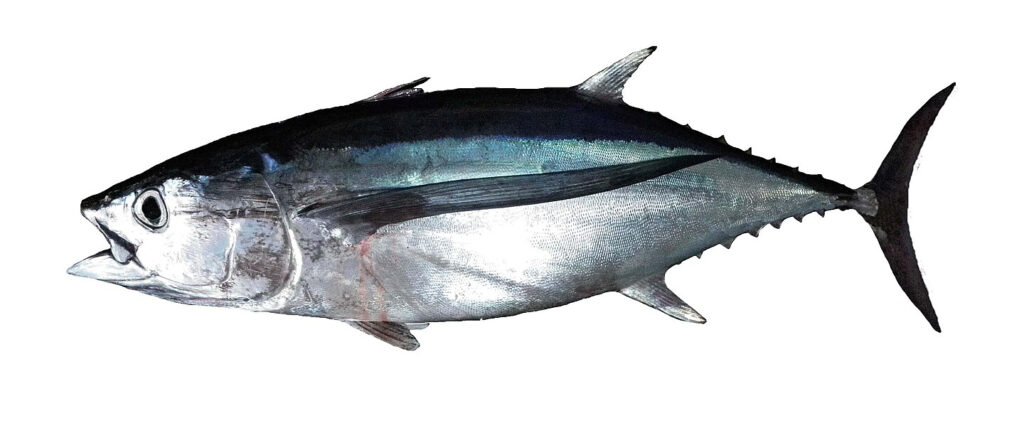
Thunnus alalunga (Wikipedia)
–
Follow me on LinkedIn to stay updated on new posts.
–
Written with the help of an AI assistant for documentation and trained on my previous texts.