Post content
My first trip to China was about 20 years ago, without Google Maps, without translators and with a wild cultural and linguistic barrier... so recently I returned to refresh my distorted memories and witness the technological evolution the country has undergone. Completely randomly, browsing Google Maps I discovered Chongqing. A city that I found fascinating, and not just because of the flavor explosion of Sichuan pepper and its cyberpunk aesthetic.
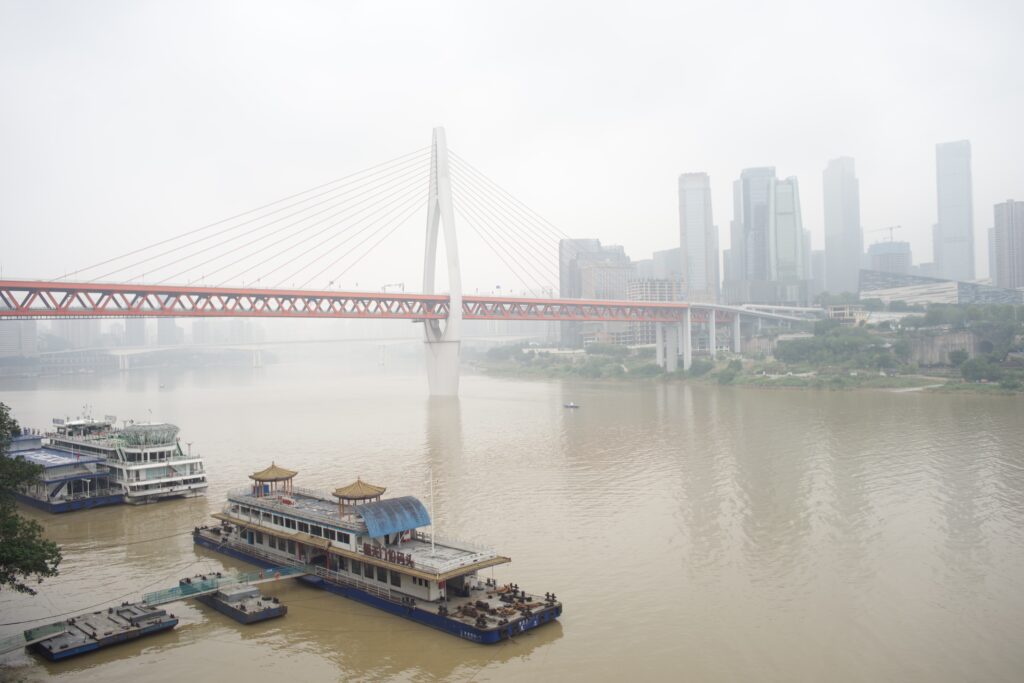
I landed in the city expecting to find a cyberpunk megalopolis... and so it was. The mountainous topography has forced the city to grow vertically. Buildings climb up the slopes, bridges connect buildings at dizzying heights... elevators and escalators are infrastructure, not luxury.
At night, neon lights tint the facades blue and magenta. LED screens project advertising that blends with digital art. It's a Blade Runner scenario materialized on the banks of the Yangtze River.
The flashes from the buildings force you to look up. That's their function: to direct your gaze toward the promise, toward the luminous future. It's the magician's right hand, the one everyone watches while he does his tricks with the left. But when you look down the narrative fractures.
On the outside, what's visible is spectacular. All shine, all promise. The problem starts when you scratch the surface. Behind the LED skin you find poor quality interiors, dirty, broken..
And the reality at street level is also different. Destroyed sidewalks, cracked pavement... and a poverty that occupies a visual level that the skyscrapers make you ignore.
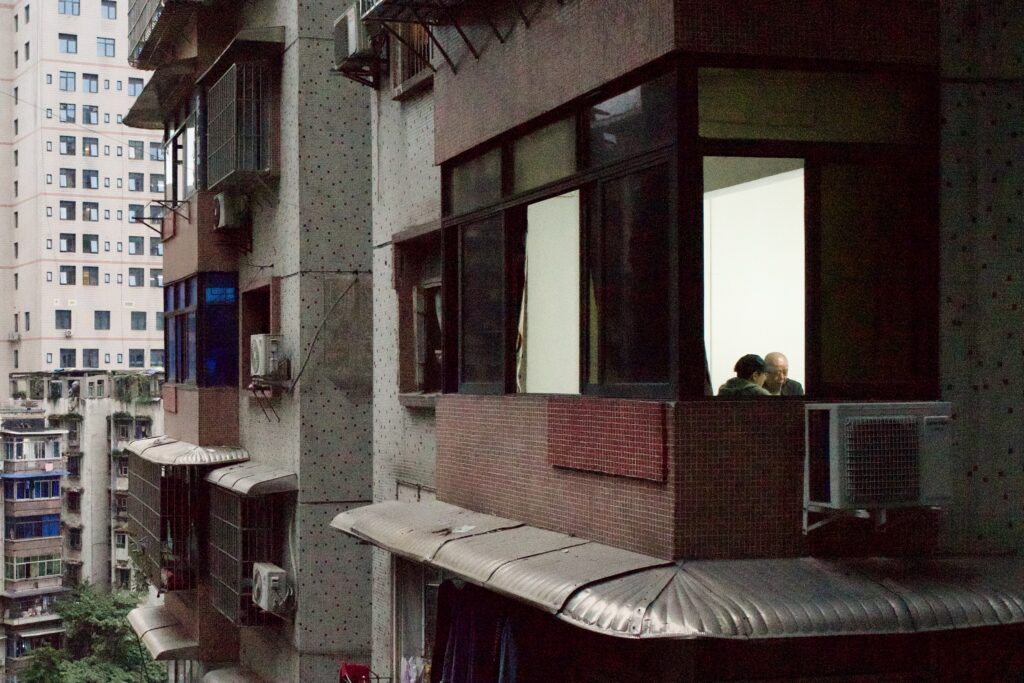
Views on Linhua Road.
The week I was there, the world's largest train station was inaugurated. But what good is it when the wild urbanism prevents anyone with a small disability from moving around the city. Endless stairs, slopes without ramps. The future, apparently, doesn't contemplate everyone.
Chongqing's old neighborhoods promise something different. Their wooden structures, their red lanterns, their curved roofs offer a contrast to the glass modernity. They are the settings that cameras seek to capture 'the real China'.
When you enter these 'preserved' neighborhoods, the illusion vanishes. What seemed like heritage conservation turns out to be another mercantile operation. The old buildings have become shells that contain outdoor shopping centers. The classic dwellings are cardboard facades that house franchises, generic souvenir shops...
The rehabilitation hasn't consisted of restoring. It has consisted of converting history into merchandise, heritage into scenery, memory into a consumer product.
The traditional facade is maintained to reassure the tourist seeking authenticity, but any trace of authentic life is eliminated. What remains is a simulacrum that's perfectly Instagrammable but fundamentally dead.
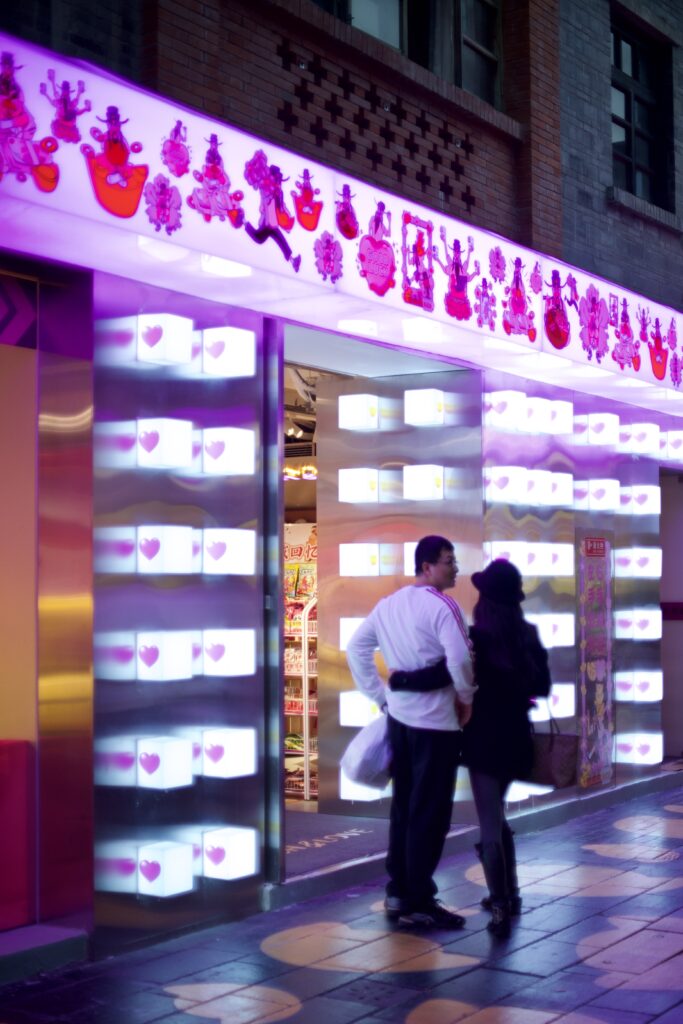
Couple in the Shibati neighborhood.
But the most revealing thing isn't the buildings. It's observing how that same facade logic replicates in people.
I had never seen a landscape so saturated with people taking selfies. Young girls and boys, adults, elderly... all socioeconomic strata are part of this collective, obsessive, almost ritual choreography. Tripods deployed in front of every Instagrammable scenario. Thousands of burst photos. Rehearsed poses.
The wealthiest hire professional photographers who approach them next to monuments, tablets in hand, showing their portfolios. The service promises an improved version of yourself, an image that surpasses the reality of who you are.
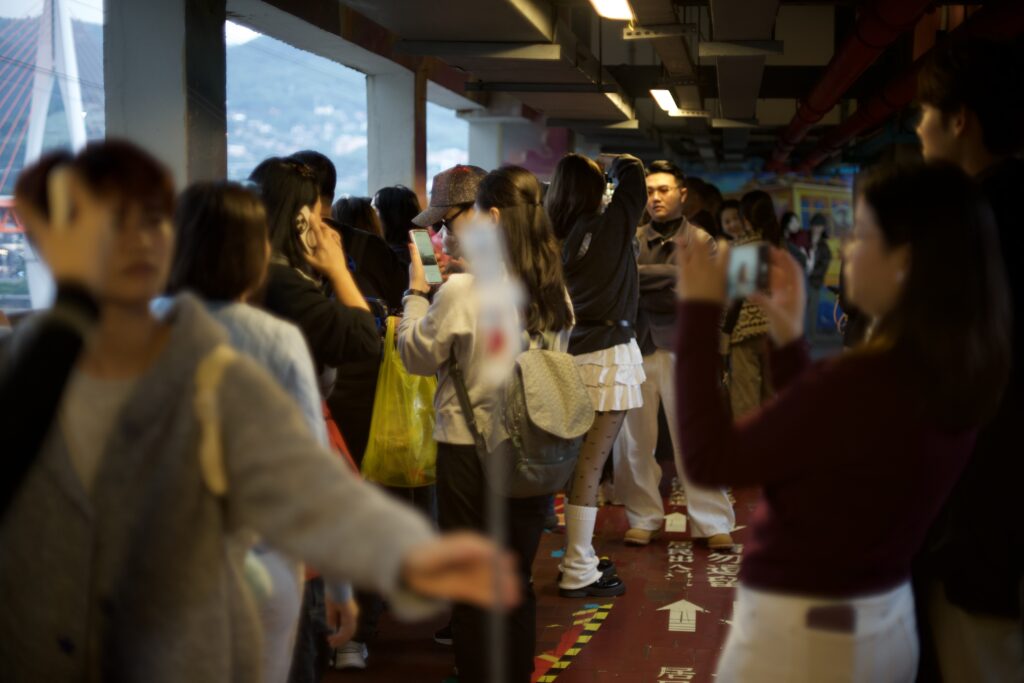
A young man posing for a photographer, surrounded by people taking photos in the Baixiangju building.
The logic is identical to that of skyscrapers: build a dazzling surface while the ground you stand on remains invisible. Whether it's LED screens covering buildings or surgically altered bodies. Image becomes identity. Personal narrative replicates national narrative.
Instagrammer Lea.Unveilchina posts:
"Chinese Gen Z no longer admires the West so much. Now they think it's China that is more advanced."
The narrative is working. Entire generations have grown up surrounded by this mirage architecture. They have internalized the equation: height equals progress, shine equals modernity, facade equals essence.
If the facade is convincing enough, there comes a moment when the distinction between appearance and reality dissolves.
There's something profoundly human in the desire to project an improved image of oneself. We all participate in that impulse. But there's a difference between cultivating an identity and building a facade. The first implies coherence between what is shown and what one is. The second is pure surface, brilliant but fragile, spectacular but hollow.
Facades work: the narrative is built brick by brick, pixel by pixel, selfie by selfie. If you direct your gaze upward with enough insistence, the cracked ground can remain invisible.
But every facade also has a cost. And that cost is collected in the reality it hides.
China isn't building skyscrapers and mega infrastructure. What China builds, with each bullet train line, each impossible bridge, each vertical city... is a narrative to position itself. A framing exercise that seeks to establish a simple equation: China equals future.
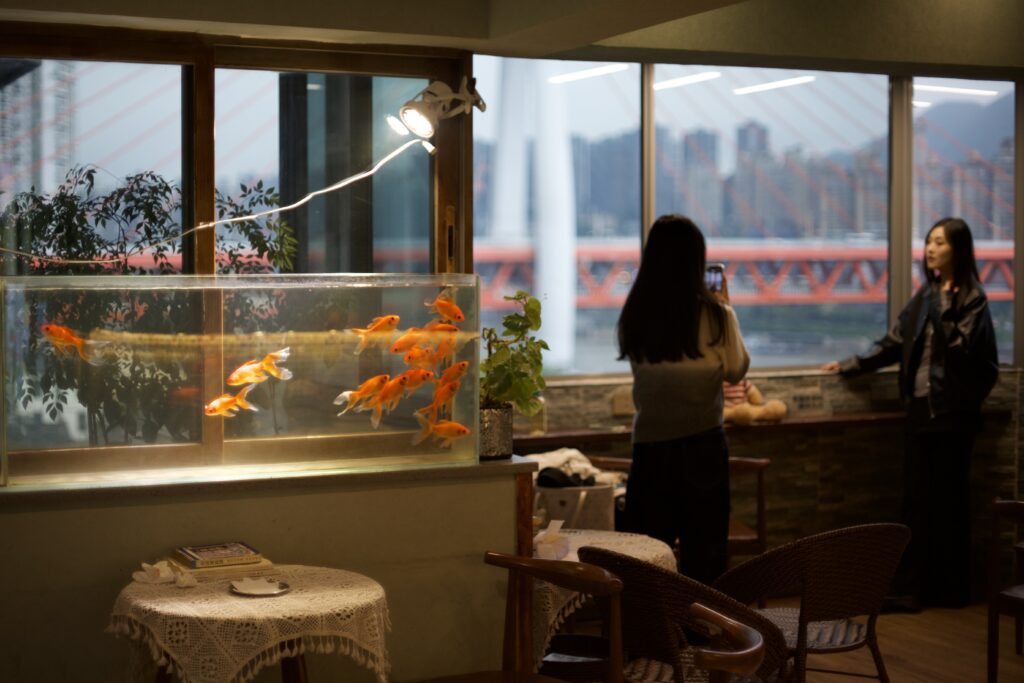
Girls taking photos in the Baixiangju building.
–
Follow me on LinkedIn to stay updated on new posts.
–
Written with the help of an AI assistant for documentation and trained on my previous texts.