Post content
BSO: Kick by INXS.
–
The roaring twenties, the economic prosperity lived in the interwar period.
A moment full of artistic, cultural and technological dynamism. The adolescence of jazz and the maturity of Art Deco. President Warren G. Harding's "Return to normalcy", a slogan that tastes like a preview of the era we would live 100 years later.
It is during these years that radio reaches its moment of glory as a mass communication medium. Supported by the development of microphones and electrical recording and registration in the mid-decade.
However, in Australia many people lived oblivious to the birth of swing and the excesses of the Roarin' 20s.
A good part of the population inhabited (and inhabits) the western area of the country. In small villages or houses lost in the middle of the desert and far from any urban center. Isolated from the electrical grid, unable to access radio and, by extension, what was happening, not in the world, but in their own country.
The disconnection of these people was not only informational, it was also from access to the health system. For these reasons, in the mid-decade, reverend and minister John Flynn contacts young engineer Alfred Traeger to develop a device. A device so that families living in remote locations could have access to medical advice and help.
The artifact had to be cheap, resistant and easy to use.
So Alfred designed a radio with reception and transmission capacity that, literally, worked on pedals.
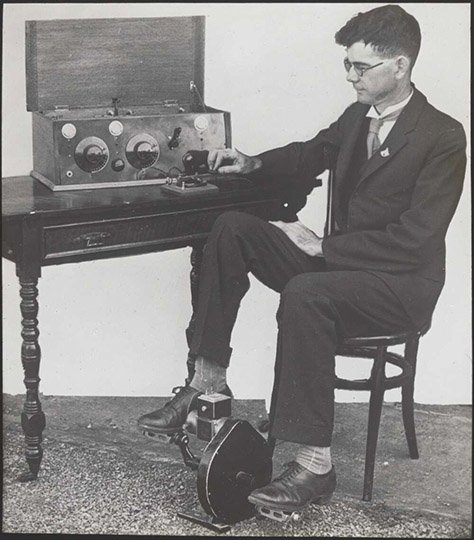
This radio allowed people living in isolation to connect with each other, with the world, with doctors and, later, with teachers.
It was a tremendously important invention in Australia, as it enabled the creation and dissemination of the Royal Flying Doctor Service and, later, School of the Air.
School of the Air was (and is) a distance education system. The official broadcast of its first lessons was on June 8, 1951, through the Royal Flying Doctor Service. And, from there, until today, changing form and means but not intentions.
School of the Air allowed all Australian children to enjoy a basic education. Regardless of their location, remotely, in 1951.
And 1969 arrives.
40 years after the pedal radio and only 20 more after the birth of School of the Air man has reached the moon and rock has devoured jazz.
Martin Dougiamas is born in a small town in the interior of Western Australia. His childhood takes place in the desert, 1,000 km away from the nearest school. His education consists of materials supplied by plane and lessons and support received through School of the Air.
This type of educational experience does not prevent him at all from having a successful academic career: he graduates in computer science and education. And develops a doctoral thesis titled The use of Open Source software to support a social constructionist epistemology of teaching and learning within Internet-based communities of reflective inquiry.
"Much of my school education was undertaken in distance mode via School of the Air, using shortwave radio. I had half an hour of contact with a teacher per day, with several hours self-directed study using worksheets and projects. Moving to the city in my teens, I attended a normal high school, followed by seven years of University education. At University, I studied Engineering, Physics and finally Computer Science, and then gained some intensive experience programming visualisation systems for the mining industry".
– Martin Dougiamas
Surely influenced by the experience lived during his childhood, constructivism, both individual and social, mark his vision of education:
"Constructivism is building on knowledge known by the student. Education is student-centered, students have to construct knowledge themselves. Explanations can use metacognition to explain via metaphor. Semiotics, or meanings of words, are important to keep in mind. Constructivism is a theory, a tool, a lens for examining educational practices".
– Martin Dougiamas
Imagine you're 12 years old and live isolated in the Australian desert, what value would you give to the little knowledge of the external world you have access to? How would it influence you?
Constructivist theories derive from Jean Piaget's studies on cognitive development. The Swiss psychologist stipulates that there is a progressive reorganization of mental processes based on biological maturation and experience with the environment: children construct knowledge of the world through discrepancies between what they know and what they discover. Knowledge is not transmitted "pure", it is influenced by previous experiences.
This seems obvious nowadays, but not at the beginning of the 20th century.
And, of course, it's applicable to adults, as Dougiamas explains well:
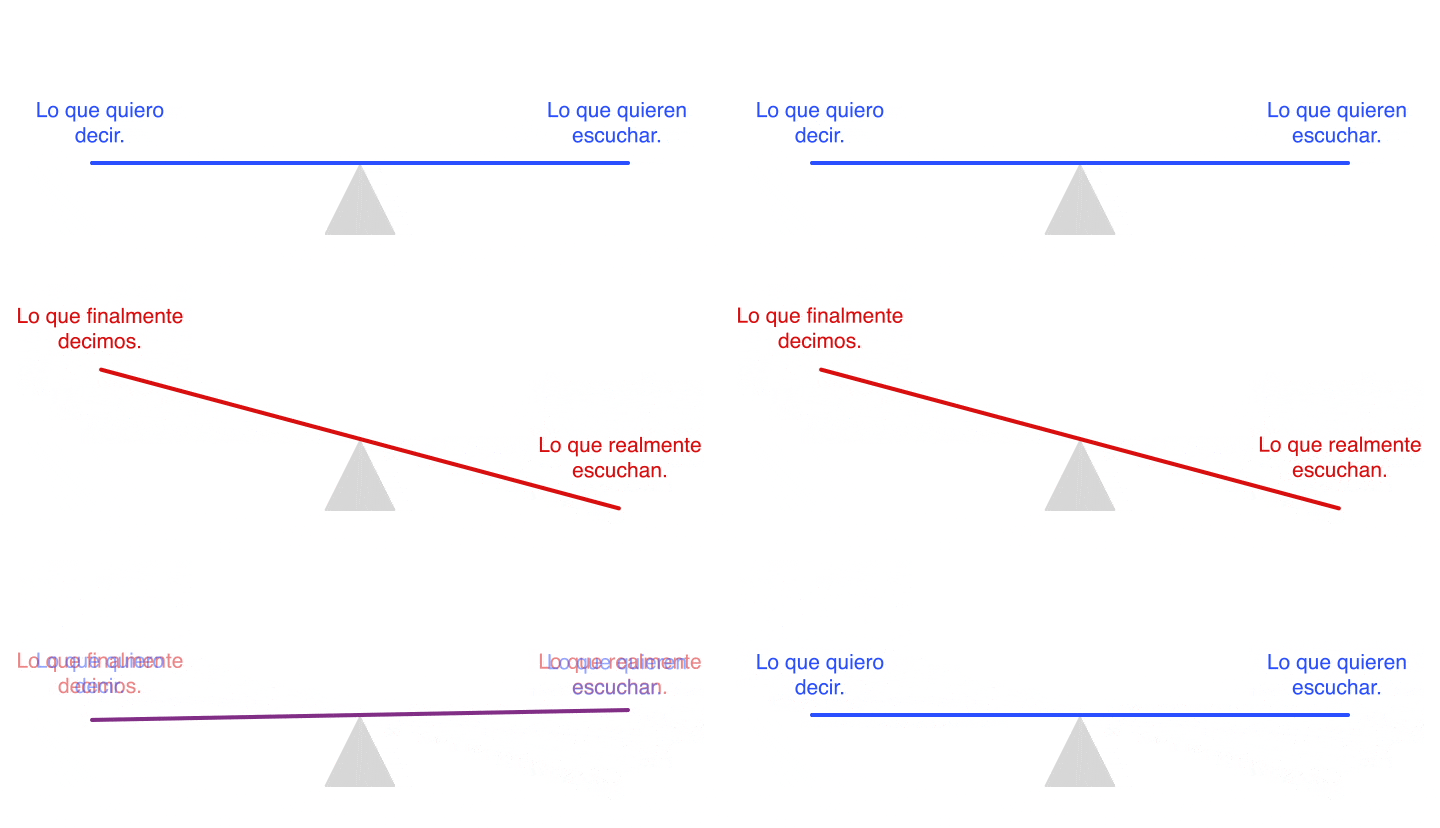
"For your own learning, this single essay is a very poor vehicle, no matter how clear I try and make it. Here I am, late at night, stringing together words about constructivism in my word processor, and there you are, reading these words using your own cognitive framework, developed via your own unique background and frameworks of language and meaning. I am translating a variety of texts, using them to build an understanding on my own background, then translating my new understandings into building my own text, which you are deconstructing to reconstruct your own understanding".
His words reminded me of a graphic that Iván Leal showed us the other day in the Verbal Design course at Instituto Tramontana, with other nuances and applied to knowledge instead of language:
But Dougiamas's motivation and interests go far beyond the theoretical and, in 1999, he creates the online education platform Moodle. According to themselves:
"Moodle is a learning platform designed to provide educators, administrators and students with a single integrated, robust and secure system to create personalized learning environments."
An online teaching platform that encompasses 340,000,000 users spread across 244 countries and that, probably, would not exist if there hadn't been someone pedaling behind a radio.
On the other hand, School of the Air continues developing specific technologies and methodologies to improve the dissemination of education among those people living in remote areas.
Surely reverend John Flynn and Alfred Traeger would be proud of the legacy they have left to subsequent generations.
How will remote education evolve in the next 100 years?
Thanks to Miguel for showing me the connection between Moodle and School of the Air.
–

–
References:
https://en.wikipedia.org/wiki/INXS
https://en.wikipedia.org/wiki/Warren_G._Harding
https://en.wikipedia.org/wiki/History_of_Australia_(1901%E2%80%931945)#The_Inter-war_years
https://en.wikipedia.org/wiki/Alfred_Traeger
https://en.wikipedia.org/wiki/John_Flynn_(minister)
https://en.wikipedia.org/wiki/Jean_Piaget
https://en.wikipedia.org/wiki/Egocentrism
https://en.wikipedia.org/wiki/Constructivism_(philosophy_of_education)
https://dougiamas.com/archives/a-journey-into-constructivism
https://es.wikipedia.org/wiki/Martin_Dougiamas
https://dougiamas.com/archives/readwrite
https://en.wikipedia.org/wiki/Social_constructionism
https://en.wikipedia.org/wiki/Royal_Flying_Doctor_Service
https://en.wikipedia.org/wiki/School_of_the_Air
https://en.wikipedia.org/wiki/Roaring_Twenties
https://australian-children.com/school-of-the-air