Post content
Soundtrack: Spotify has recommended this fantastic playlist titled French Jazz Café. Probably because of my fondness for Serge Gainsbourg.
–
I've been trying to finish this post for fifteen days.
Not because it's very complex or because I haven't had time to write it, but I feel a certain responsibility to do it in the best way possible. I want to convey in the most appropriate way one of the first (of many) things we learned with Javier Cañada in the Interaction Design Program at Instituto Tramontana and I'd like to do it with the utmost respect for the knowledge acquired.
Finally I've come to the conclusion that, instead of trying to make it perfect, it's better to finish it than leave it half-done. So, if any former Institute student (or anyone else) reads this, I'll be all ears if they want to contribute something.
Task-centered design
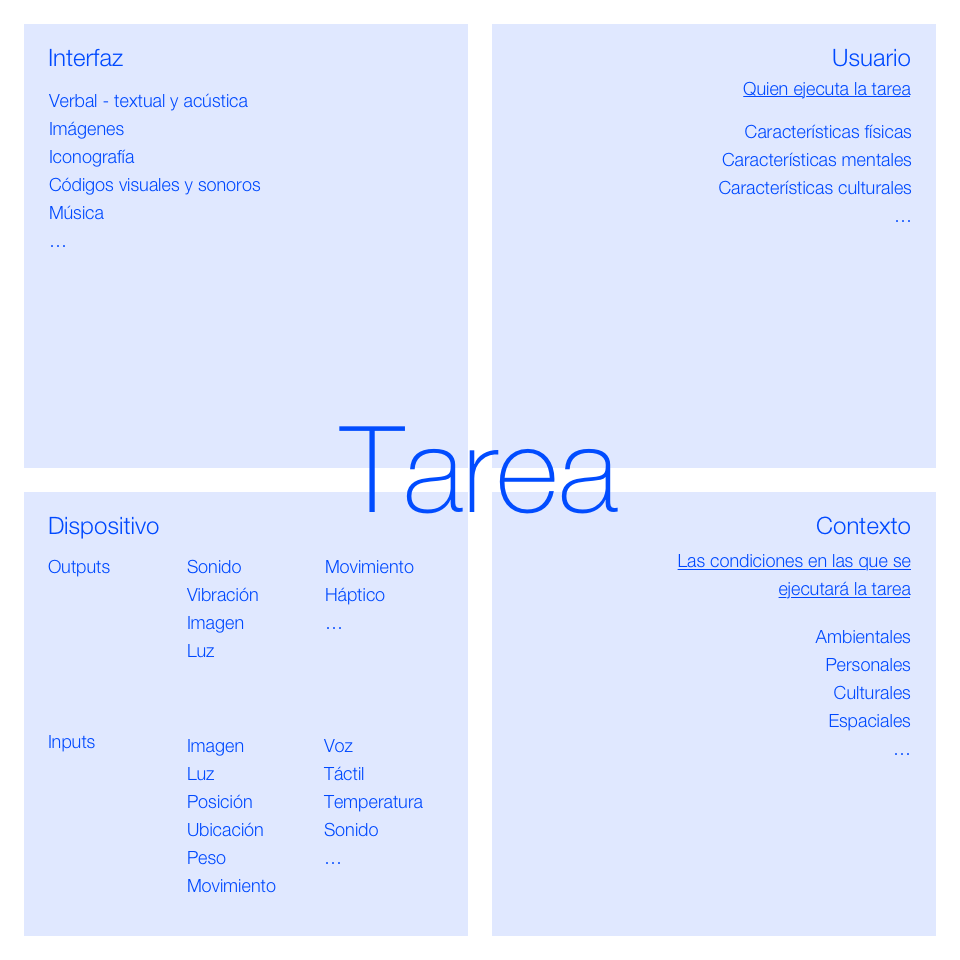
It's a process through which information is gathered from the four elements involved in the task to be executed (user, context of use, device and interface) for analysis and subsequent projection of a solution that facilitates and optimizes the process that the user will carry out.
On one hand we have the user and their physical, mental and cultural characteristics,
On the other hand the context, which are the conditions under which the task will be executed. We can make an analysis as concrete as "the user will be lying on the couch" or as abstract as "in post-modernity the existence of multiple realities according to different individuals is accepted".
When analyzing how the device will relate to the user, we'll evaluate the possibilities it offers us in terms of outputs (what it can emit/transmit: sound, vibration, image...) and inputs (the information it can gather from the outside: sound, temperature, voice...).
It occurs to me now the possibility of the duplication of this element in certain contexts. For example, if I'm wearing a virtual reality headset in the metaverse using a virtual slot machine (to say something), would two devices be co-existing in superimposed layers (the physical and the virtual)?
The fourth element is the interface, which will convert signals from both sources into comprehensible ones for both: from person to device and from device to person. The interface can consist of verbal communication (both acoustic and textual), its iconography, visual and sound codes, music, etc.
These components are not immutable, quite the opposite, there's a deep relationship between them that makes them dependent on each other and modifies them accordingly. Especially between user and context and device and interface.
We don't act the same when we're relaxed as when we're overcome by stress or fatigue, nor when it's raining or when the weather is nice. The user is not an unchangeable automaton. Their environment will modify their behavior and limit them.
On the other hand, the interface will depend on the device (which will have more or fewer outputs and inputs available).
The interface will change according to the device and the device will take different form according to the context.
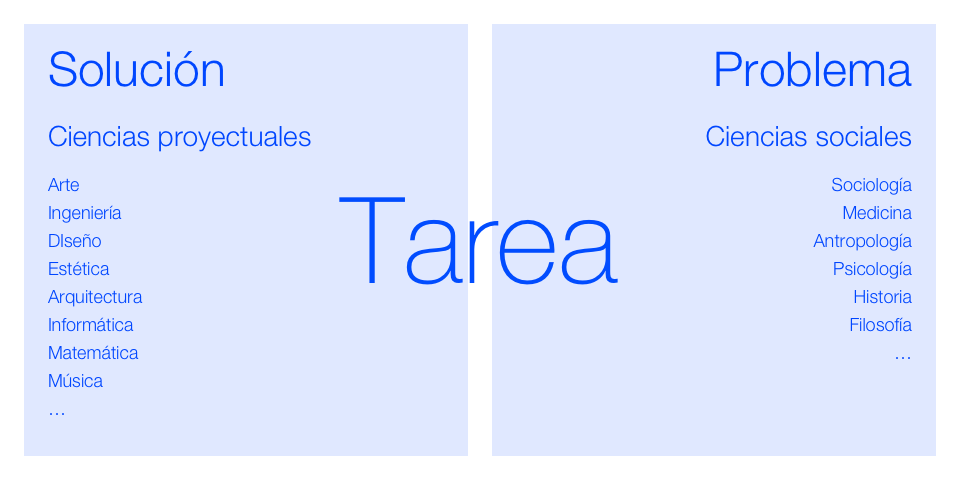
User and context are part of the problem and it's the social sciences that allow us to analyze them: psychology, history, philosophy, etc.
The solution will be provided by the design sciences: architecture, design, computer science, etc.
For these reasons it's fundamental that a designer possesses a holistic vision of the world, with the educational complexity that comes with acquiring broad cross-disciplinary knowledge.
More knowledge, more capacity for reflection. And, the more information we have and the deeper the analysis, the closer we'll be to the best solution.
The process is similar to solving an equation with four unknowns. And we don't always have to start solving it with the user, but sometimes we'll have to do it through the device, interface or even context.
The more unknowns we solve, the more certainty we'll have in the result of the others.
–
User Centered Design vs Task Centered Design
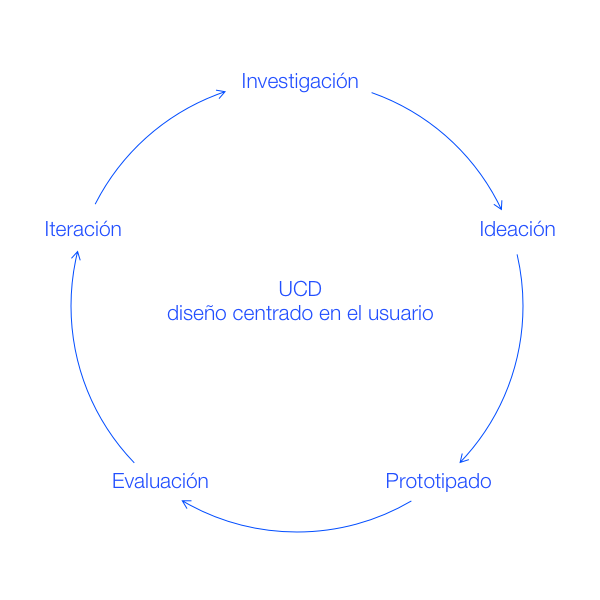
What's common in product design is to talk about user-centered design (UCD – User Centered Design). I won't go deep into this method since there's a lot written about it, just in case I'll leave here the link to Wikipedia and this simple graphic:
Some personal opinions:
- UCD tries to establish in a sequential manner mental processes that will differ greatly from one designer to another. We all have different mental structures and I don't think it's convenient to standardize the way each one develops a solution. It implies linearity and, in a certain way, alienates your thinking to a predetermined sequence.
- Task-Centered Design provides a framework of knowledge and analysis that, in the search for the solution, favors an internal dialogue that can be linear or chaotic, brief or prolonged, analytical or intuitive but that depends on each individual and the team.
- Making users the protagonists of the process can subvert the designer's thinking, restricting novel ideas due to prejudices established in users' minds due to their previous experiences.
- I quote a well-known phrase by Henry Ford:"If I had asked people what they wanted, they would have said faster horses."It's more likely that designing a solution in which users are involved implies problems derived from the rearview mirror effect that McLuhan talked about.
- The user's responsibility towards the product seems to be diluted the moment users influence it excessively, potentially perverting the act of designing by turning it into one of co-creation. This, at times, can cause emotional distancing between the designer and the functionality/product they're working on. This might be good, or not, I'm not sure
- We designers are responsible for the experience the product provides, we know its circumstances, its point of maturity and the path ahead. We must decide whether or not it's necessary to make users who don't have the same information we do part of that process.
- The product is ours, not the users' or clients'.
Follow me on LinkedIn to stay updated on new posts.