Post content
Soundtrack: Bill Evans – Waltz for Debby
–
"I want you to be creative, effective, sophisticated."
This phrase is not from a design team leader inspiring his colleagues. It's not someone sharing a common goal and much less a polite request.
It's an order. A perverse and chilling order.
An order from Ariel Sharon to his generals during the Second Intifada.
An order that didn't refer to defining an attack or defense strategy, nor to the design of new weaponry, but to killing Palestinians:
"[The Palestinians] They have to wake up every morning and see that ten or twelve of their people have been killed and not really know what happened. I want you to be creative, effective, sophisticated." – Ariel Sharon
Creativity, effectiveness and sophistication: three concepts a priori more typical of an architecture studio or a design team than a war squadron.
–
Weeks before the war in Ukraine began, I received a wonderful gift in the form of a book: "Walking Through Walls: How the Israeli Army Appropriated Postmodern Critical Theory and Reinvented Urban Warfare" by Eyal Weizman.
I think it's an appropriate time to share my thoughts on the text that made me think about war (and the people who are part of the army) in different terms.
Its author, Eyal Weizman, is a British-Israeli architect who leads the research group Forensic Architecture at Goldsmith. This multidisciplinary team uses architecture and technology to investigate cases of state violence and human rights violations.
In its pages he describes and analyzes the methodology of the Israeli army. Citing numerous times Aviv Kochavi, current commander-in-chief of the Israel Defense Forces (IDF).
Inverse Geometry
The war between Israelis and Palestinians took place in an urban environment that favored the latter: it was their territory and they knew it in detail. It had been defined by them and they possessed it, both metaphorically and literally. Israeli incursions only managed to increase casualties in their own ranks without achieving significant advances.
The scenario changed when Aviv Kochavi, influenced by his philosophy studies and the teachings of the OTRI (Operation Theory Research Institute), introduces the concept of inverse geometry (nothing to do with reverse engineering), which consists of "the reorganization of urban syntax executed through a series of micro-tactical actions."
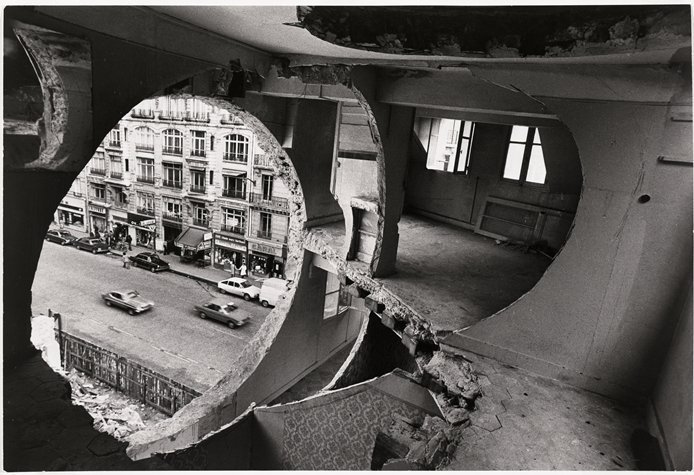
This, which sounds almost poetic, in practice simply consisted of breaking walls (literally) to traverse areas without having to transit through the streets that were in Palestinian hands.
"We took this micro-tactical practice [of going through walls] and turned it into a method. And, thanks to this method, we were able to interpret the entire space differently." – Aviv Kochavi
What defined the space was not its own physical limits, it was the movement of Israeli soldiers. Outside and inside cease to exist.
Kochavi decided to design the context.
He rewrote the rules of the game and, whoever writes the rules of the game, has much better chances of winning.
Says Kochavi: "If walls try to contain the natural entropy of the urban, breaking them would mean releasing new political and social forms."
Currently we are witnessing other examples of "urban" context design (non-warlike): the charter cities like the utopian Próspera or the crypto paradise Satoshi Island.
Are we witnessing a déjà vu of modernist Brasília? Or are we just seeing how capitalism seeks scenarios to satisfy its cravings?
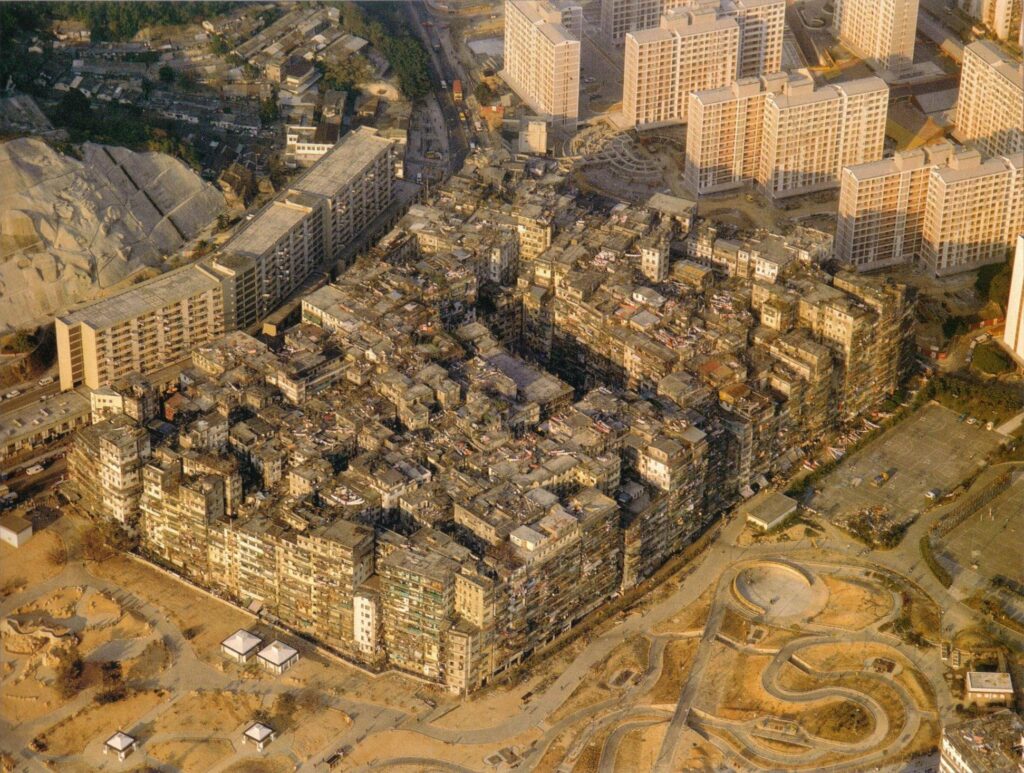
On the other extreme we have the dystopian Kowloon Walled City (what would Blade Runner be without it!) or, looking for something more current, Skid Row in Los Angeles.
We can get conspiratorial and think that Amazon or Just-Eat are behind the dark stores/kitchens with the objective of getting ground floors at good prices at the cost of modifying urban life.
But this is nothing new, it's obvious that there's a correlation between urbanism and society.
The difference is the existence of a prior, intentional design.
Kochavi talks about micro-tactics to modify space. He doesn't intend to reformulate the entire urban environment at once, but rather applies small modifications that gradually redefine it. It's similar to the way digital products iterate through the implementation of micro changes so that the user assimilates it progressively and it doesn't result in a cognitive shock that generates confusion.
Paraphrasing my colleague Dani at Visual MS:
Changes in the micro that mutate the macro.
And Kochavi turns that practice into a "method," where we designers fall obsessed, trying to systematize the chaotic nature of mental processes to increase productivity.
That obsession with the methodological that, deep down, takes us away from the intellectual and reflective and brings us closer to the production line, to the figure of the soldier who without questioning tears down a wall to go through it.
The Swarm
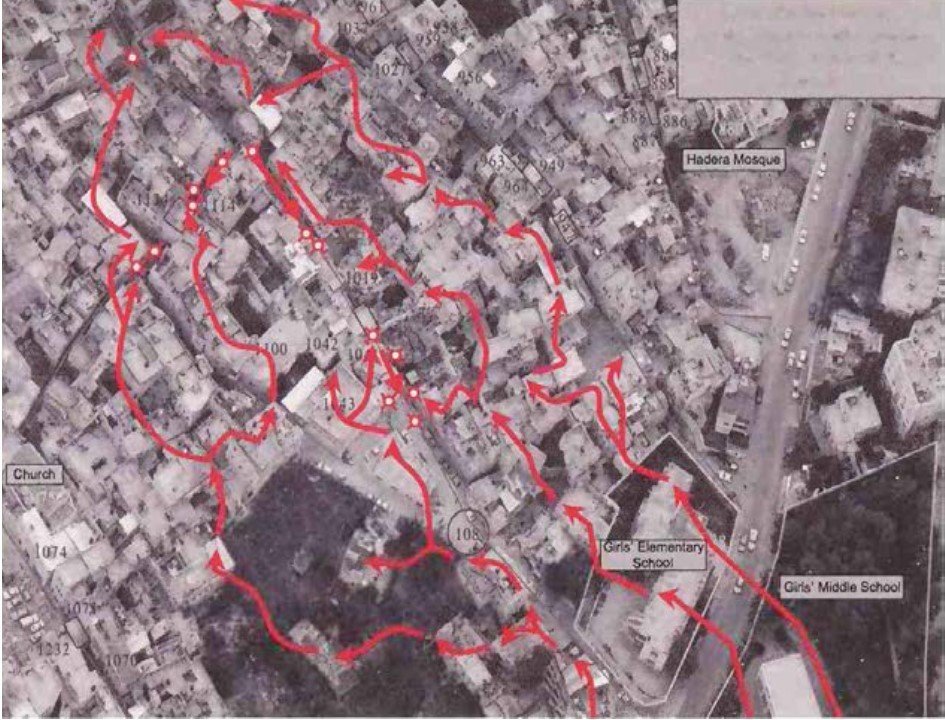
Source
"Swarm theory attempts to describe military operations as non-linear warfare: a network constituted by a diffuse multiplicity of small semi-independent but coordinated units, operating with all others in a generalized synergy." –Weizman
I find it curious how there's a similarity between the swarm structure created by Kochavi and the two-pizza team theory that Jeff Bezos proposes.
Small teams with decision-making power and a common objective, creating "an intelligence greater than the combined intelligence that results from its constituent parts" (Weizman).
On the other hand, the book has erased the stereotype of military personnel I had formed in my mind: the crude, square, uneducated bureaucrat we see so much in movies.
The high command of the IDF were trained by OTRI covering diverse subjects like philosophy, communication and architecture. For example, a small part of the bibliography they handled:
- The timeless way of building: patterns of events, patterns of space, patterns of language
- Architecture production
- The myth of the machine
- Cybernetics of human learning
- The Postmodern Condition
- The vision machine
Now I have no doubt that there are military personnel who are authentic intellectuals with broad multidisciplinary training, becoming soldier/poet/philosophers like samurai or the main characters of Zionist mythologies. And that, precisely that training, is what allows them to tear down walls.
–
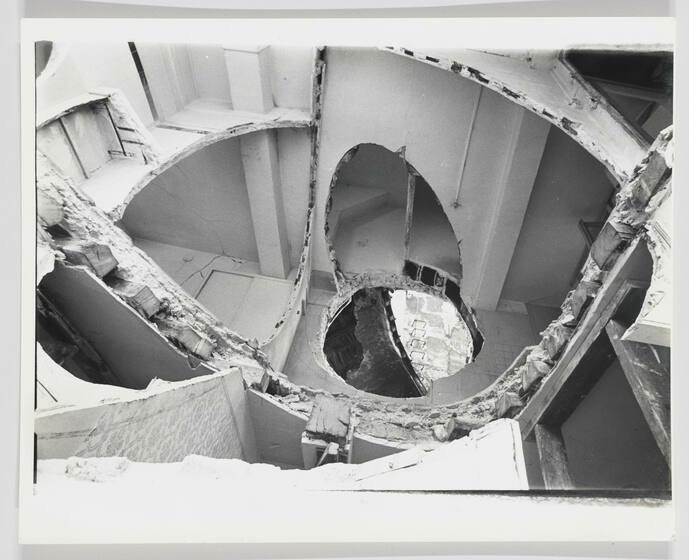
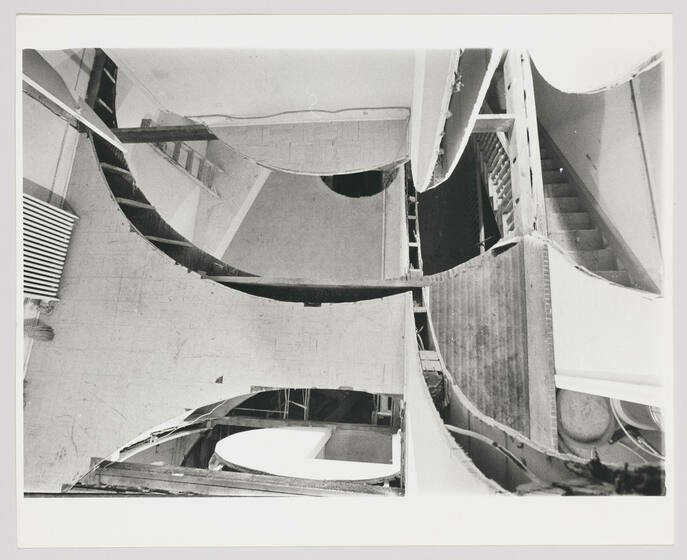
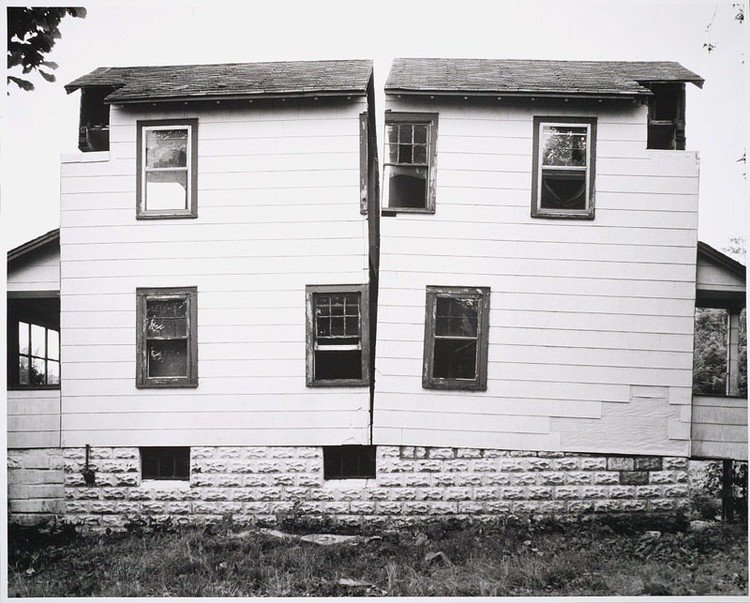
I would like to end by clarifying a point: most of the photographs that accompany this text are works by artist and architect Gordon Matta-Clark. Pure visual poetry that finds beauty in the deconstruction of space.
These images of Matta-Clark's interventions accompanied OTRI presentations, inspiring Israeli military personnel with new systems to assassinate Palestinians.
Inspiration to assassinate them in a creative, effective and sophisticated way.