Post content
Soundtrack: Wagner – Die Walküre, WWV 86B / Act 3 – «Hojotoho! Heiaha!»
–
Year 1905, Mannheim, Germany. Luise Máthilde Wilhelmine Hommel gives birth to our protagonist.
Years later the family would move to Heidelberg. And when the young man comes of age to choose a profession, he decides to follow in his father's footsteps: architect. So he moves to Karlsruhe, then to Munich and finally to Berlin, to study at the Technische Universität. There he excels under the tutelage of Heinrich Tessenow, a renowned urban planner and architect. It's also during this time that he meets Rudolf Wolters, with whom he forges a great friendship that would eventually be cut short in the future.
Although, in the following years, he would make other kinds of friends.
"The simplest form is not always the best, but the best is always the simplest."
– Heinrich Tessenow
It wouldn't be until 1931 when he joins the Nazi party, becoming member 474,481.
Berthold Konrad Hermann Albert Speer thus laid the foundations to become the regime's architect.
To become the person who would end up regularly dining with Hitler.
The one who would end up being one of the führer's favorites.
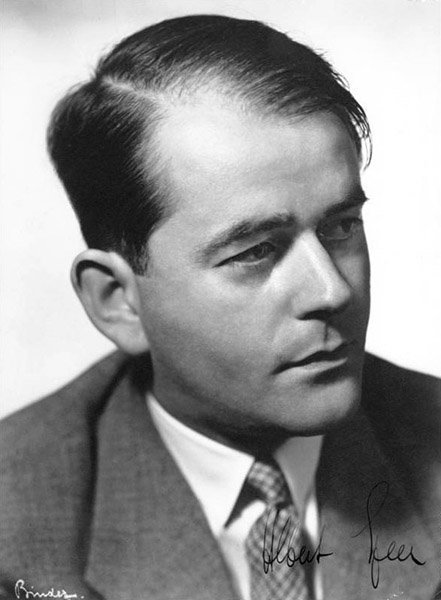
Under Adolf's wing (the bad one, not the other one) he took charge of the party's most grandiose works. All under the epic that defined the German Volksgeist of the era: a recovery of neoclassical architecture magnified by excess and the use of a scale that departed from the human. Almost touching the divine.
The buildings not only had to be beautiful when newly constructed, but, applying the theory of "ruin value," they also had to be beautiful when turned to rubble. A theory that perhaps was an unconscious premonition of the war's outcome.
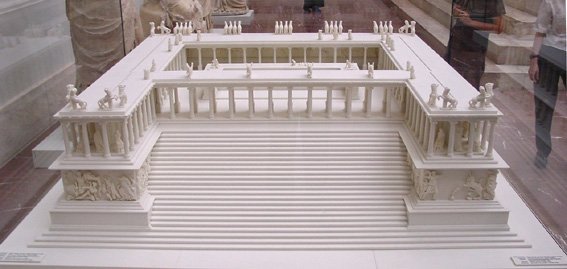
The perfect example of this is Speer's design that later received the nickname Cathedral of Light. The work was based on the Pergamon Altar but with a size upgrade.
Hitler, ahead of his time, said: "The function of the artillery and infantry will be taken over in the future by propaganda."
So they added an extra layer of theatricality, artifice and epic to the building in the form of light (also to hide the fact that it wasn't finished yet).
150 anti-aircraft searchlights placed at the back of the building projected kilometers of light columns into the sky (actual fact). All upward, vertical. Just like Gothic cathedrals. Toward God.
And 240,000 people in communion, raising their eyes to the heavens.
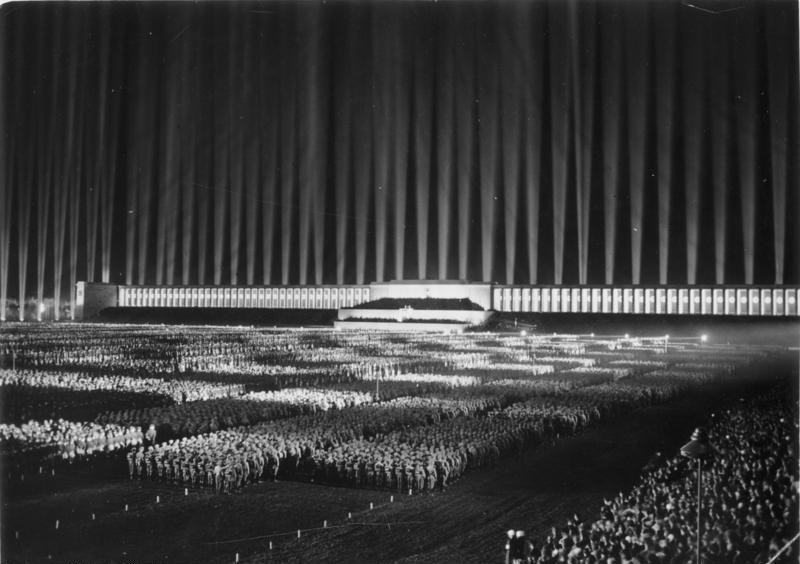
I'm fascinated thinking about how attendees of such events must have felt. Paradoxically, I imagine that witnessing something of such magnitude with a crowd of people sharing the same beliefs wouldn't make them feel small, but like giants.
After such a spectacle, how could they not think about the possibility of winning the war?
–
I first read about the Cathedral of Light in The Vision Machine, by Paul Virilio (part of OTRI's bibliography) and I was struck that something that could be considered so contemporary had already been used 70 years ago. Now projections and video mapping are common forms of expression but light art wasn't considered an artistic trend until the late 60s.
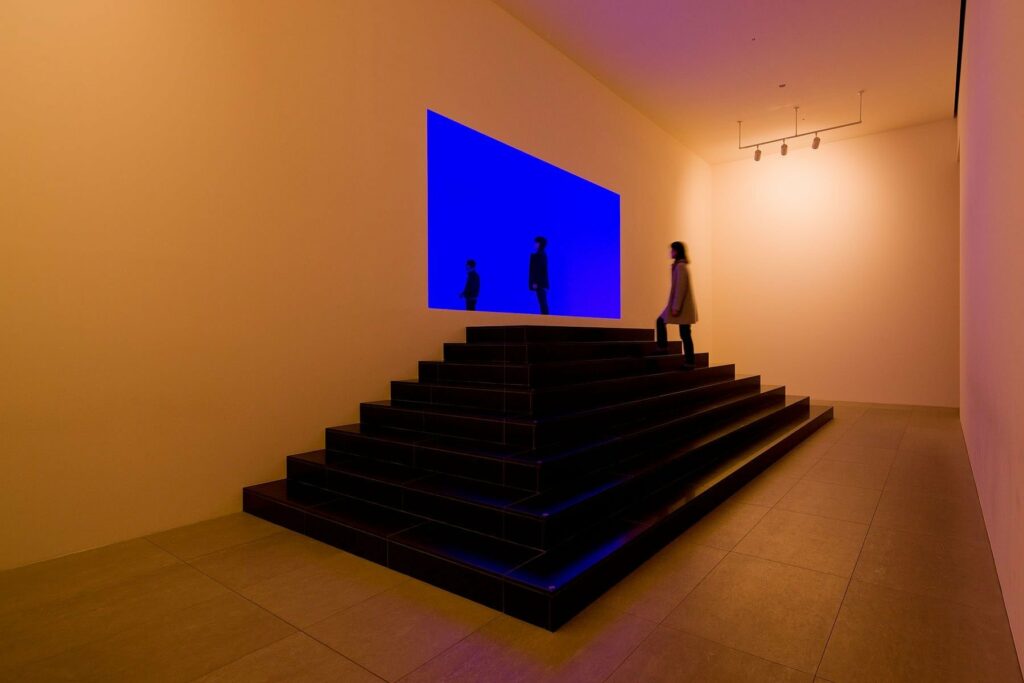
Speer's use of light has made it impossible for me not to remember when in 2019 I visited the Chichu Art Museum in Naoshima. The museum is a Tadao Ando design and, despite its size, houses very few works.
One of them is an installation by James Turrel:
In it you find a staircase with eight steps that end in a small room. When you finish climbing them, you enter the upper chamber, where a light that gradually changes colors causes you to lose your perception of space. At the back, a small opening creates the sensation that you have a void before you.
The staircase, element that "separates" you from the earthly. Metaphor for divine ascension. Light and color to move and disorient the viewer.
From my point of view, probably wrong, the nexus that unites the various works of the Chichu Art Museum is the connection with the divine, with the spiritual.
But that story is for another post.
–
A note:
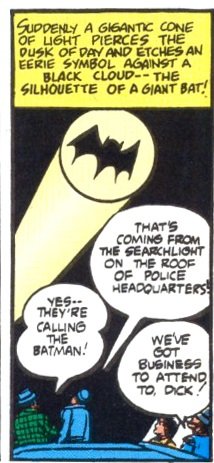
The Bat-signal first appeared in 1942, a few years after the construction of the Cathedral of Light...
Follow me on LinkedIn to stay updated on new publications.