Post content
Soundtrack: the album 22, a Million, by Bon Iver, which extensively uses the OP-1
–
For a baby, there are no rules of the game.
He grabs a ball and kicks it: fun guaranteed.
I speculate that what produces enormous happiness is the dopamine release caused, perhaps, by achieving small victories in his psychomotor development. That's his world, his game: kicking balls without an objective.
As children we establish social relationships and play (the playful for the sake of playful) becomes formalized, turning into games (with established rules).
"Games are formalized expressions of play which allow people to go beyond immediate imagination and direct physical activity."
Once our fun is rationalized we include objectives: let's see if I can do 50 touches without dropping it, goals, etc.
That way we pervert the original game, the one that is free from sin since in it we cannot corrupt any rule.
Just yesterday, while taking a walk by the dock, two girls passed by me playing at jumping and one, in a display of social rebellion, said to the other: "Any type of jump counts."
As if she said: "Now let's be free."
The vast majority of objects that surround us are perverted by that anxiety for formalization, systematization and, especially nowadays, measurement of objectives. It seems we need them to be stripped of any hint of innocence.
There are exceptions, like the OP-1 by Teenage Engineering.
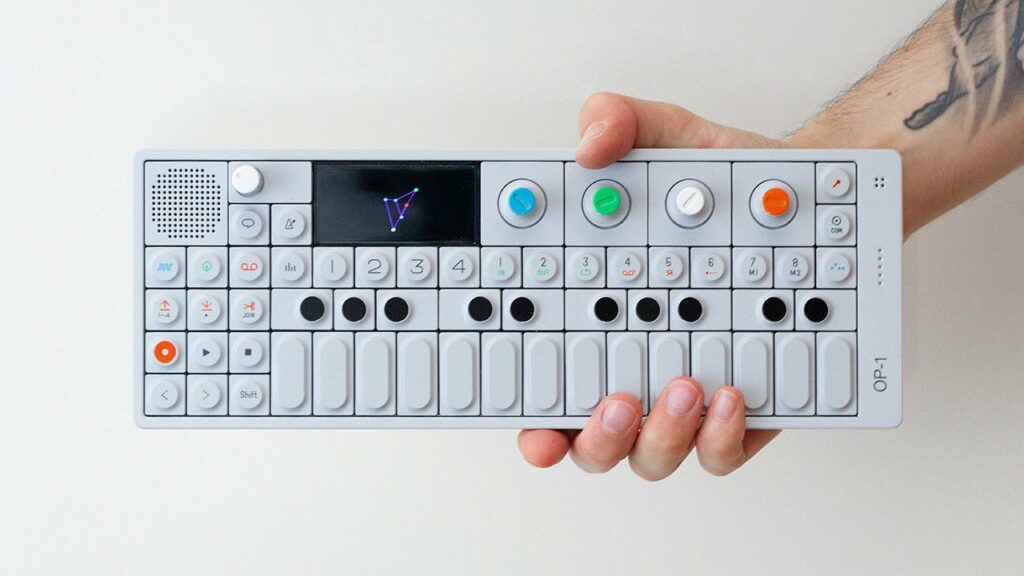
Much has been written about the OP-1 as an object for making music, but I think little has been written about the product design, beyond the clear influences of Dieter Rams.
But... what is the OP-1?
We could say it's a standalone music production station: it has synthesis capabilities, sequencers, effects, 4-track recorder, sampler... it even has radio. It's a Swiss army knife for working with sound.
However, just like a Swiss army knife, it's small. Its size is ridiculous for something of its power. If I remember correctly, it was Steve Jobs (maybe someone else said it but I'm going to attribute it to him) who said that a small object produced an emotional connection with its user since they felt the need to protect it. And that happens with the OP-1.
Despite its size it's heavy: it feels solid. Its physical qualities make you perceive it as a whole object.
Personally, I think what really makes an object whole is that it's coherent with the decisions that have been made in its design. An honest product that's consistent with itself from the moment of its conception. The OP1 is also that in this aspect.
Beyond its Ramsian influences (I have no doubt it would be the synthesizer that Dieter would have), its designers clearly drew inspiration from synthesizers like the Casio PT80 and the Casio VL-Tone. Eighties synthesizers for children.
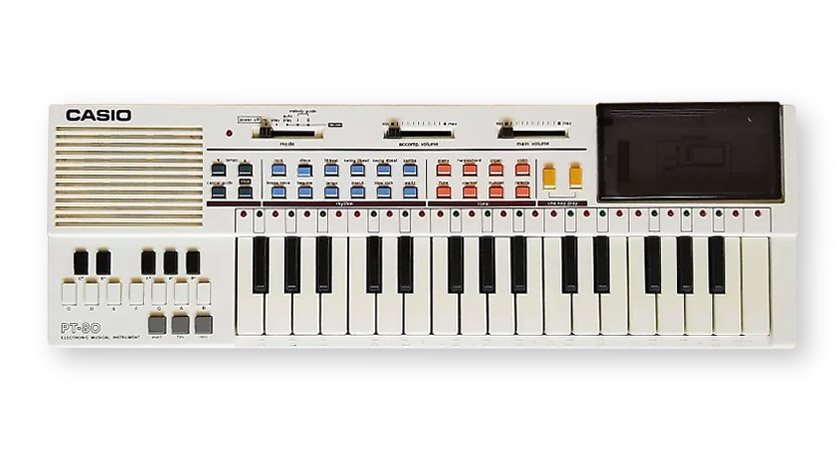
But, as we'll see later, other parts of its interface are also coherent with those references to the 80s.
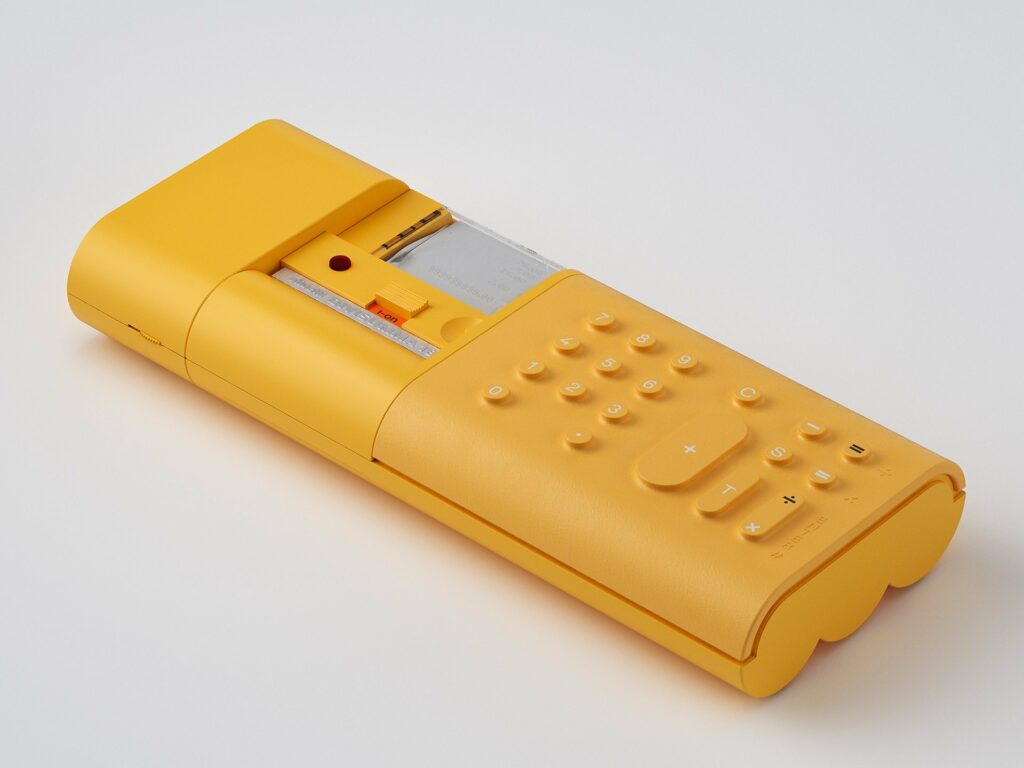
The next thing that catches attention are the buttons and keys (far from the classic shape and arrangement of black and white keys). They've clearly been molded in the image of the buttons from the Divisumma that Mario Bellini designed for Olivetti in 1972.
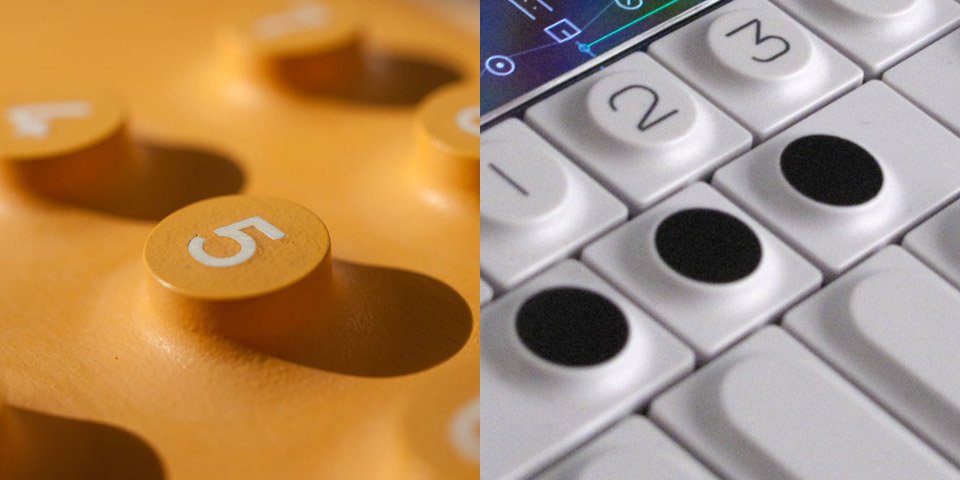
Another detail that fascinates me is the feel of the potentiometers, which transmit a click at each step while you turn them. It powerfully reminds me of those produced in iPods with click-wheel, something that, personally, produced a very pleasant sensation.
Its color palette is sparse (mainly blue, green, white and orange) and is executed in a way that, intuitively, you associate colors with resulting actions. Color is the guide that helps us connect the different elements.
But where I think it really differentiates itself from the competition is in its graphic interface. In it, the people at Teenage Engineering decide to practically shed the classic language used in synthesizers to surrender to the playful.
There are no figures that determine the value of a parameter, almost no references to wave types, nor to filter type, there are sequencers that aren't even tied to a tempo... most things work by pure intuition and others have their own rules, which don't always relate to musical ones.
The OP-1's design is clearly based on recognition. Aside from certain functionalities, everything is so obvious and intuitive (or so intentionally obscure and unintelligible) that you can use it directly when you turn it on for the first time. The learning curve is practically non-existent. (Its absolute opposite would be the Octatrack, which I might dedicate an article to later.)
I would have to dedicate many posts if I wanted to analyze each of the synthesis engines/sequencers/effects it has, so I'm going to limit myself to showing a couple of sequencer examples that seem very significant to me (videos directly from Teenage Engineering's channel):
Tombola
Sketch (Do you remember the Etch A Sketch?)
And that obsession with games also permeates the design of its accessories, some of them compatible with Lego.
Let's keep in mind that the market is saturated with hardware products for music production. and, if you work with software, you only need a DAW to exponentially multiply your number of options.
However, the OP-1 is about establishing barriers to all functionalities with the objective that you really focus on the music you're making and not on infinity of parameters. And that you have fun doing it, that you reconnect with the child you were who played recording cassettes (I apologize for the forty-something millennial example).
I would have liked to see a conversation between its designers to discover how they decided to establish the limits in the interface... and to know the amount of "no's" they said to themselves when thinking about adding layers of complexity.
I was reading an interview the other day about a product, whose designer explained: "lack of features is our main feature". I think it can also be applied to this one to a great extent.
The OP-1 is the synthesizer of homo ludens in its purest form.
It allows us to ignore the rules, it frees us from common sense and rationalizing obsession.
So that while making music, we can say:
"Any type of jump counts."
–
Some OP-1 users: Thom Yorke, Deadmau5, Beck, Depeche Mode, Jean-Michel Jarre, OK Go, Chvrches, Tame Impala, Bon Iver...
Follow me on LinkedIn to stay updated on new publications.