Post content
I put Plus, by Vegpher on in the background with the intention of writing a post about form and sound that I've been mulling over in my head for quite some time. And I realize I couldn't have made a better choice. Even the cover seems to fit:
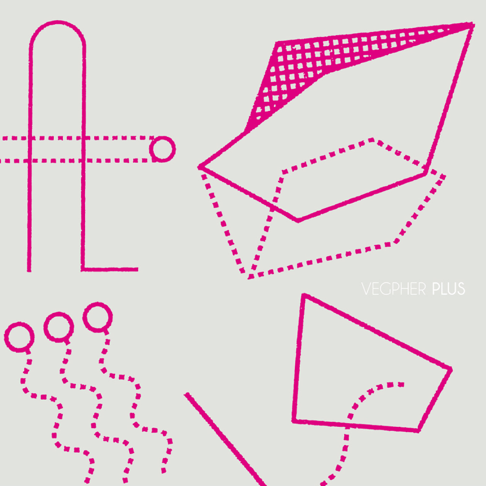
Because this text is about the similarities between the form that objects possess and the type of audio wave that seems to accompany them. And how, perhaps, this can help us make decisions in the design process.
In fact I thought I had already covered some of these points before, but I've discovered that they've probably remained in some draft.
I think it's fundamental to start with the Bouba/Kiki effect which, according to Wikipedia, consists of a non-arbitrary mapping between voice sounds and the visual form of objects.

Broadly speaking, this psychological effect consists of unconsciously assigning soft sounds to soft forms and more "sharp" sounds to forms with pronounced edges.
On the other hand, there are 4 basic types of sound wave: sinusoidal, triangle, sawtooth and square. The curves of the sine wave become increasingly pointed until the completely right angles of the square wave.
In acoustic terms, sound is also perceived as "soft" and "gentle" in the sine wave and becomes more aggressive and with more harmonic content as the wave acquires edges.
Ableton Live's Wavetable synthesizer allows us to easily experiment with this transition between waves:
Can we then extrapolate it to the form of objects to establish an acoustic framework that helps us determine the sound design of our product?
If we're designing the audio for an interface, perhaps this way of referencing acoustic signals to the visual can help us establish more coherent patterns that the user assimilates as a whole. Because if we're creating a complete and integral experience, it's fundamental that all elements are aligned.
Obviously acoustic design is much more complex and there are many more factors to consider beyond making a correlation between the form of the product/interface components and the audio wave... but those aren't the subject of this post.
I don't intend to propose a sound design for the cars I talk about below. I want to reflect on whether the appearance of the object helps us determine, at least in part, its acoustic foundation.
As an example, I find it very illustrative to compare two well-differentiated cars: the Tesla Cybertruck and the Porsche Mission E.
In the Cybertruck we encounter marked diagonals, its edges and vertices powerfully reminding us of a sawtooth wave:
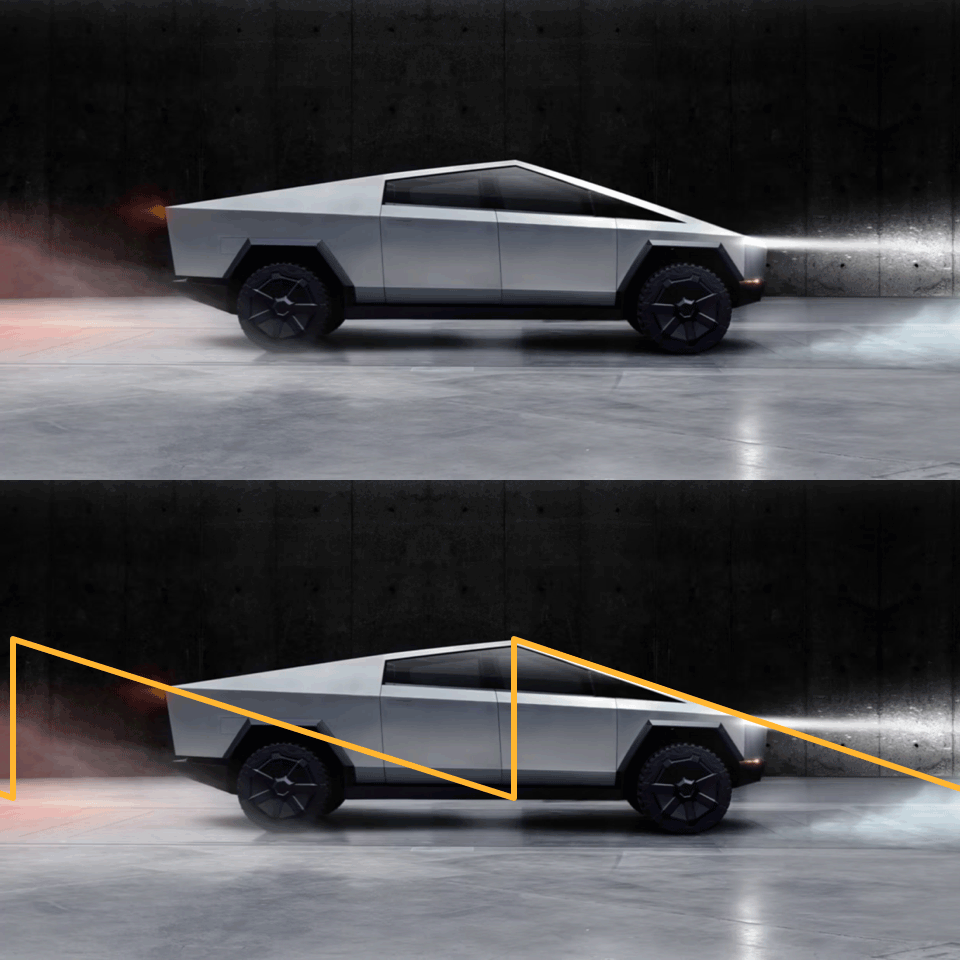
This car that transports us to post-apocalyptic futures seems taken from Blade Runner or an electric Mad Max... and let's not forget the aggressive sounds of Vangelis' synthesizers in the soundtrack of the original film:
On the other hand we have the Porsche Mission E with much softer forms that lead us to a sine wave that begins to transition to a triangle type:
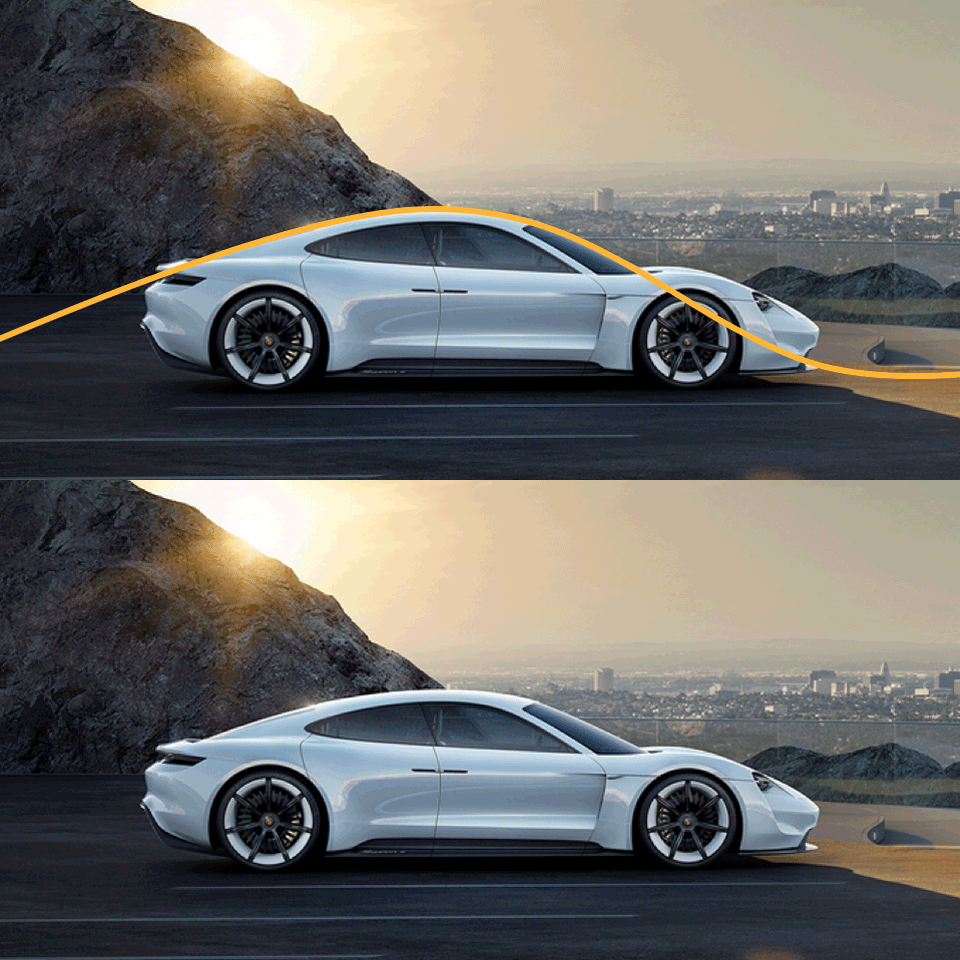
This design takes us to a minimalist, electric, clean, flat future... but slightly aggressive, more due to the red rear position light that runs from side to side than the form, reminding us somewhat of HAL from 2001: A Space Odyssey. It could be considered a warning to drivers behind it.
It's closer to a utopian science fiction film. With all due respect, it has an air of the Audi from I, Robot, to give an example. Forms that lead us to sounds more typical of current interfaces, like a Facebook/Meta notification.
Another existing example: Wall-e and Eva.
Which car would each one drive?
Perhaps the Bouba/Kiki effect also explains an unconscious relationship between the form of the object and its own sound.