Post content
Curiously, I started writing this post on Monday, March 8th and, the next day, I watched the Language episode from Tramontana's Interaction Channel.
In their video, the references are about language in general, while my reflections are about written language (or at least they start with it). In any case, the video has influenced and enriched some of the ideas I was planning to write about.
Soundtrack: Ryuichi Sakamoto – fullmoon
Anyone who knows me well knows that I'm fascinated by Japan and, although I could dedicate a post to Japanese design, there's one thing that attracts me enormously: their writing. Or, rather, the use of kanjis, also used in Chinese. But they attract me beyond the aesthetic, it's something much deeper. To explain where I'm going we have to start from the beginning:
What is a kanji?
According to Wikipedia kanjis are a logographic writing system. This means that a character by itself represents a word, as opposed to "Western" languages where a succession of letters is required to form a complete meaning.
In summary, when a Japanese person encounters the kanji 魚 in a text, they're automatically seeing a fish in their head. There's no reconstruction of a succession of letters to form that image.
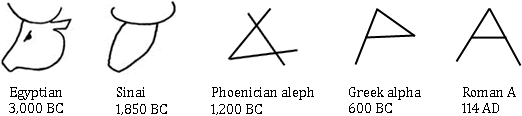
But what seems wonderful to me is the way in which written languages as different as Japanese and Spanish really start from the same base: simplifying representations of real elements into figures that subsequently compose a text. That is, first ideas were simplified graphically: icons were designed.
In essence, a Japanese person seeing a kanji and the concept "fish" coming to mind is not very different from when we see a floppy disk in an application and automatically think "save".
To visualize this evolution, I'll give concrete examples, like that of the letter A:
And that of some Japanese words, I think seeing the evolution the meaning is quite intuitive and transparent:
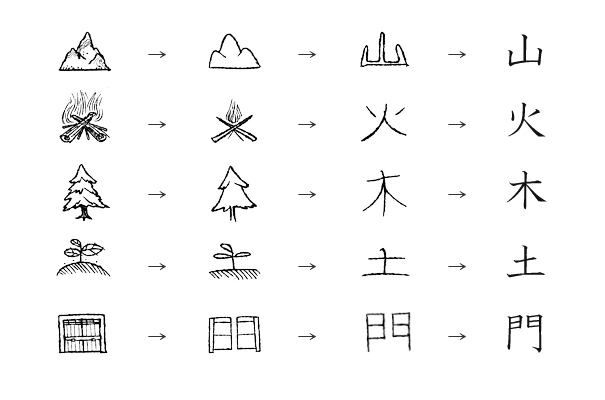
The point I want to reach is that, over thousands of years both cultures have been carrying out a simplification and abstraction of concrete elements from nature. Creating icons that have derived into kanjis with complete meaning in the case of Japanese language and into individual characters with which we build concepts in the Latin alphabet.
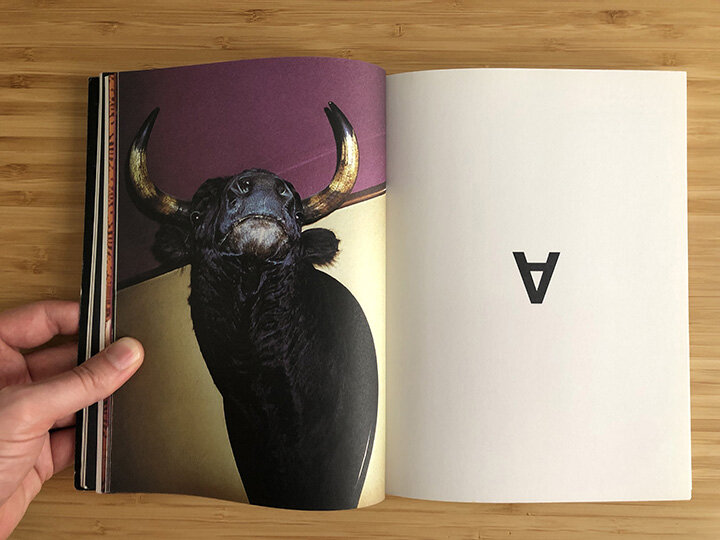
And this leads me to a question, one I've been turning over in one of those sleepless nights.
Is written language still evolving, devolving, or converging interculturally?
What led me to this question?
The use and abuse of emojis in written communication.
When the representation of mountain is closer to " 🗻 " than to the word "mountain" with all its letters or to the iconographic simplicity of the kanji "山", are we moving backward or forward? Or are we perhaps approaching a universal language where those emojis are readable by all cultures unequivocally due to their lack of abstraction?
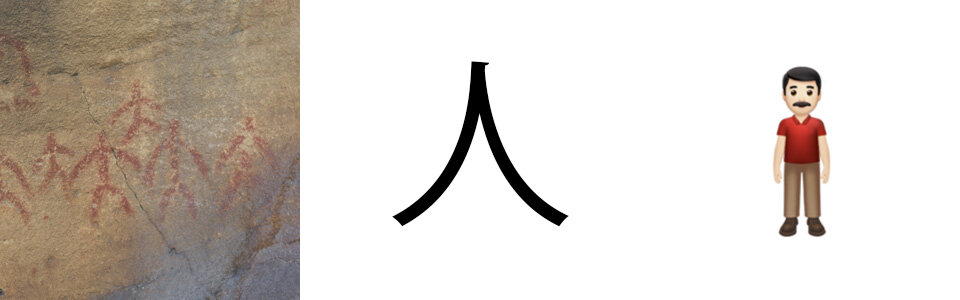
In my opinion it's devolution: returning to the beginnings, to a language lacking development, to a moment of pre-abstraction.
This, partly, "worries" me since I believe language is being destroyed.
I won't get conspiratorial but nowadays tools like Instagram encourage a simplification of written communication.
You just have to see how they advise you to comment with a "❤️" or a "👏" instead of helping to create a good discourse that contributes constructively to dialogue. In fact, the typical thing is to enter a post and find something like this:
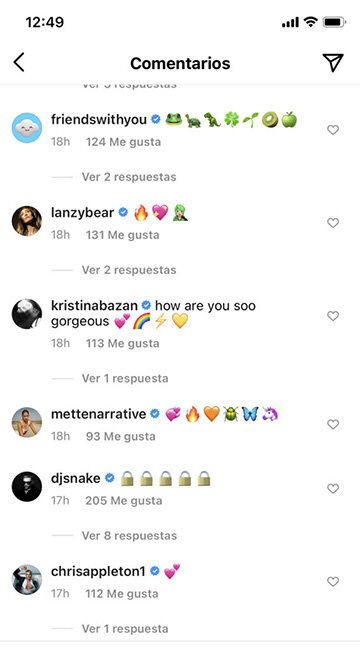
The image corresponds to a post by Dua Lipa made a couple of days ago, but I could give examples from any influencer's account.
And here I connect with Tramontana's video, which references how in the dystopia of 1984 the language used intentionally decreases its vocabulary so it only serves to express the regime's postulates.
Furthermore, if the Sapir-Whorf hypothesis is valid and language conditions thought, isn't the use of emojis limiting our mental capacities?
Or, simply, is the speed at which everything flows, the ephemeral nature of what we're exposed to, guiding us to make everything as simple as possible to communicate efficiently?
However, this also makes me think about how it might be linked to the evolution of music, and how we've gone from Queen's Bohemian Rhapsody through Beyoncé's Single Ladies and, from there, to reggaeton. I had read a very interesting article about the simplification of music in these recent years of history, but unfortunately I haven't found it in the immensity of the internet.
Queen vs. reggaeton.
Just yesterday I was in a webinar about music production, led by Sr. Chen (apparently he's a recognized producer of national urban music), where he encouraged making shorter songs because it seemed complicated to write a second verse for his tracks.
Sr. Chen argued that, if the singer has said what they have to say in a minute, there were no reasons to extend it unnecessarily, plus "it's very difficult to write a second verse". Then he spoke respectfully, but in a sarcastic tone about the boring rap of 5-minute tracks where the singer, I paraphrase, "gives you the whole spiel".
Shit, I'd like to know what Kase O thinks about this.
Isn't it rather the lyricist's inability to communicate after being exposed for years to micro-conversations on social networks based on emojis?
Will there then be more poetry in a Camela song than in one by Sr. Chen?
I could continue talking about how this process of simplification and search for ephemeral and Instagram-worthy impact affects the world of art and design. But I'm going to follow Sr. Chen's advice and, since I've already said what I had to say, I'm not going to write that second verse.
And what does all this have to do with design?
It's not just that it has to do with design, but that applications and digital products, as Nir Eyal explains well in Hooked, form habits and those habits shape minds.
And, after this I wonder if design is helping to improve or worsen the world and if we, as creators of applications, should be less Sr. Chen and more Kase O.
I tried to place it in the post, but I wasn't able to fit it in, so as a postscript about Dua Lipa's Future Nostalgia, one of the best pop albums I've heard in recent years.
Pure ❤️