Post content
Soundtrack: Los Piratas – Ultrasónica (Spotify) (I was going to link only Años 80, but this album is too good)
–
A few weeks ago, I don't know the reasons, I'm going to blame the vastness of the internet, I ended up getting interested in the 80s movement.
That Madrid movement that was written with V for Vigo.
Being from Vigo I grew up knowing that the city is the birthplace of groups like Siniestro Total, Aerolíneas Federales, Os Resentidos or Golpes bajos. All children of absolute post-modernity, of anything goes as a product of the Transition and the counterpoint to years of repression. All very rebellious and artistic, all very naïf.
In any case I've never been much of a fan of that music or that movement, maybe because I've never paid it the attention it deserves.
The groups from Vigo that have left their mark on me are Kannon and Los Piratas and, of course, those that, for one reason or another, I was part of. Especially Killer Barbies and, of course, HiFiStamina (which I formed with some friends who are still friends 20 years later).
La Movida and the 80s have never interested me, nothing.
And they still don't.
The thing is that, out of pure curiosity and leaving all my prejudices aside, I decided to put on the EP No mires a los ojos de la gente by Golpes Bajos, specifically the song Malos tiempos para la lírica.
And it blew my mind.
Not for its musical quality, or the poetry of its lyrics, but for the feeling.
The feeling it produced in me was nostalgia, for an unlived era of a place I've never been.
The same feeling that City Pop produces in me and, especially, one of its main exponents: Mariya Takeuchi.
City Pop is a genre that also developed during the 80s, but in Japan, almost 11,000 km away. It was born in the midst of the financial bubble and, largely, its lyrics exude wild hedonism. You only have to take Takeuchi's hit "Plastic love" as a reference. Love, yes, but for plastic: for credit cards.
It was a pre-internet moment, when access to music from the other side of the world was practically non-existent. And yet there they were, Tokyo and Vigo, Vigo and Tokyo, united by the same Zeitgeist.
Golpes Bajos talks about "bad times for poetry," while Takeuchi talks about love for the material, the artificial. The same thing, but expressed differently. The Zeitgeist, hitting hard.
To round out my fascination with that thin thread of transcontinental 80s connection, a couple of days later I discovered C. Tangana's Tiny Desk on YouTube.
I have no words to express how wonderful it seems to me, I strongly recommend you dedicate the 15 minutes it lasts to it:
The mix of Spanish after-dinner conversation and the contemporary (vocoder, autotune, synth), which could be a mix between Scarface and Jersey Shore, seems to me executed with exquisite taste: from the performances to the camera work, the props and that wonderful light that accompanies the moment. If mixing genres continued to create controversy we would probably be witnessing discussions of the caliber of when Camarón released La Leyenda del Tiempo.
However, what struck me most was, again, the feeling. Because when you see El Madrileño in that environment you can't help but feel nostalgia, probably for a place you've never been. You only have to see the comments, some of them replicate exactly what Takeuchi has made me feel for years:
- "This performance makes me homesick for a place I've never even been."
- "I'm not even from Spain and I'm from Honduras but I felt like I was from there and it made me want to dance, did anyone else feel it?"
- "I've never been to Spain, but every time I watch this I cry with joy."
Again, the importance of narrative and creating worlds that manage to connect different cultures and eras.
Like Wong Kar Wai creating new sensations based on the juxtaposition of Asian characters and environments immersed in tangos.
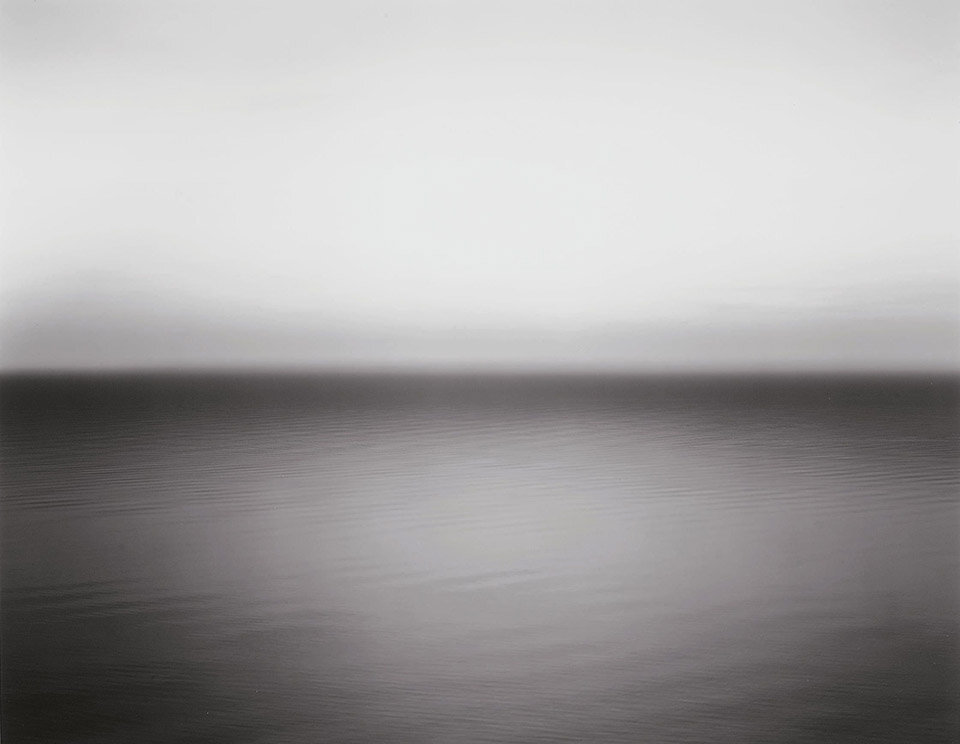
Like Hiroshi Sugimoto in his Seascapes, which he himself qualifies as time arrows. In which he seeks to capture what we can see now in the same way as what other people could see in antiquity. That obsession of Sugimoto's to capture stretches of time in a single image.
Like the island of Lost, which is nothing more than a representation of the collective subconscious where the protagonists of the series meet.
Or like in Ubik, by Philip K Dick.
And so we could find countless examples.
It's possible that we all want to belong to a world that has never existed or to converge in the one we are creating.
——
Note
Grunge appeared because pre-internet Seattle had very bad connections with the rest of the country and, therefore, was unaware of the musical movements that were developing at that time.
Sometimes, to do something totally original, the best thing is to be disconnected from the world.