Post content
Soundtrack: Alva Noto – Univrs and Ryoji Ikeda – Dataplex.
–
In the last class before summer at the Interaction Design Program of the Tramontana Institute we were lucky to have Enrique Bordes as a guest professor.
In his class he shared his vision of comics and architecture and how both relate to each other. It was tremendously interesting and, moreover, very motivating to see how Enrique has managed to combine two of his passions in perfect harmony.
So something clicked inside me and I've decided to start looking for connections between two of my favorite things: design and sound, sharing here all my reflections and common points I find between one and the other.
And where to start?
I think it's necessary to define some minimal particles to work from in each field.
In design we could establish the point (or pixel) as that basic unit from which everything begins.
This idea seems classic and very simplistic to me but I also think it's a good starting point (never better said).

According to Wikipedia:
The point in geometry is one of the fundamental entities of geometry, along with the line and the plane, as they are considered primary concepts, that is, they can only be described in relation to other similar or alike elements. They are usually described by relying on characteristic postulates, which determine the relationships between fundamental geometric entities. The point is the simplest unit, irreducibly minimal, of visual communication; it is a geometric figure without dimension, it also has no length, area, volume, or other dimensional angle. It is not a physical object. It describes a position in space, determined with respect to a pre-established coordinate system.
The pixel, like the point, also describes a position in space, but in this case confined to a two-dimensional system as it's a prisoner of screens.
While I have it more or less clear in visual terms, in sound terms I find it complicated to define what is the minimal particle that configures sound.
My first reaction would be to go with a sine wave. However, it doesn't seem entirely correct to me, since it's not perceptible to the human ear if it's above or below a certain frequency. That is, we would have to add additional conditions to the very definition of sine wave. Something like: "a sine wave above 20 hz and below 20,000 hz" (limits of what a human ear can perceive).
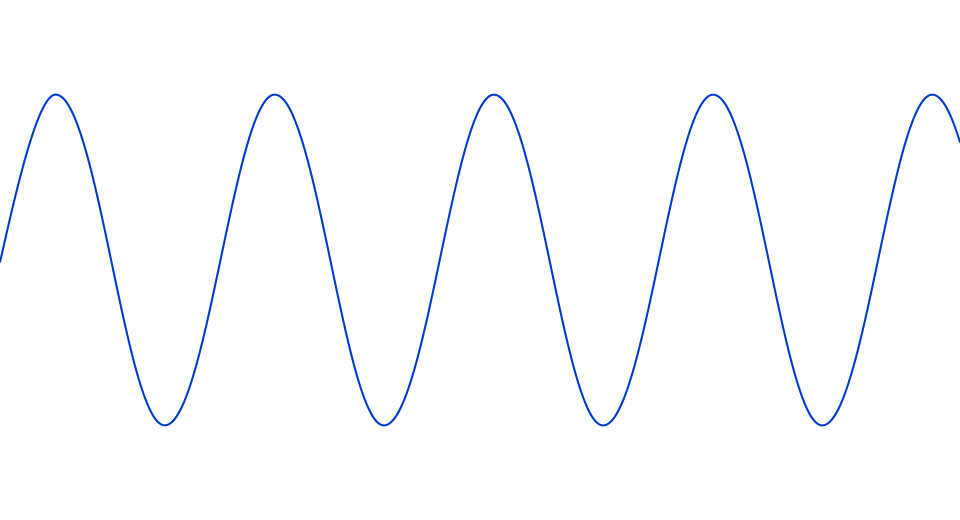
A sine wave at 440hz (440 repetitions of the wave in one second: an A note), sounds like this:
And 1/10 of a second of 440hz, is visualized like this:
My second option when establishing that minimal acoustic unit to connect with the visual (the point) is the microsound, which Curtis Roads in his book refers to as follows:
The micro time scale […] embraces transient audio phenomena, a broad class of sounds that extends from the threshold of timbre perception (several hundred microseconds) up to the duration of short sound objects (d100 ms). It spans the boundary between the audio frequency range (approximately 20 Hz to 20 kHz) and the infrasonic frequency range (below 20 Hz). Neglected in the past owing to its inaccessibility, the microtime domain now stands at the forefront of compositional interest.
The very definition of microsound includes the necessary conditions so that it's not necessary to add them a posteriori.
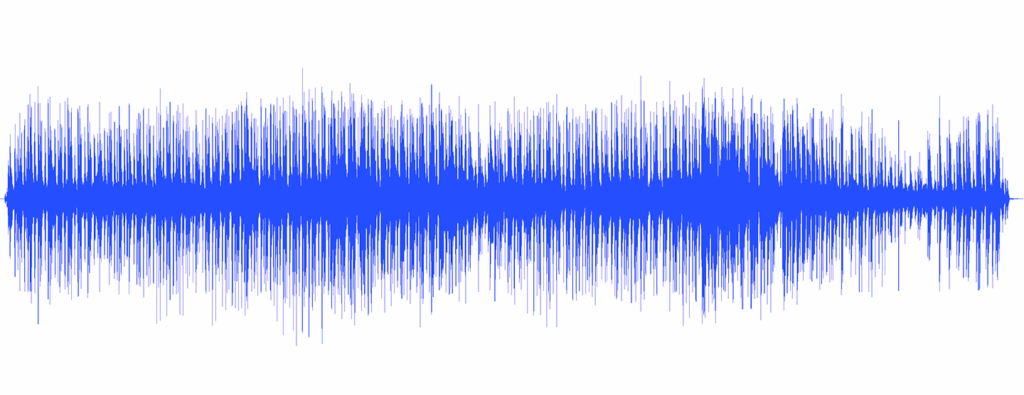
To develop an example I've chosen as a base an audio clip from the extensive BBC sample library. I've selected it because its content, consisting of percussion in the foreground and human voices in the background, adds organic nuances and an anthropocentric character that will contrast with the cold, digital and surgical sound that will be produced when we dissect it:
And we're going to extract from it a fragment of 1 ms:
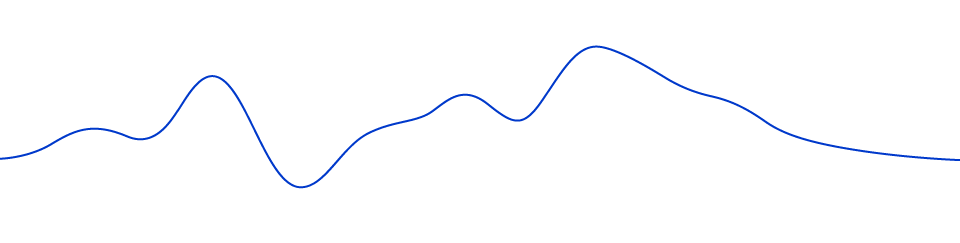
If we compare a sound to a movie with a duration of X time, a microsound could be comparable to a frame of that movie. An acoustic photograph, so to speak. Or the other way around, maybe we could define a photograph as a visual transient.
If we combine points and microsounds we get a very brief audiovisual piece:
https://player.vimeo.com/video/569458081
The next basic element would be the line, which is defined by the distance between two points.
By introducing the concept of distance we can also start talking about a key element: time.
After all, a line is the visual representation of a point's journey from origin A to destination B. Something inherent to the point that, after all, defines a position in space.
That line is traced by a succession of points that, through repetitions, forms a stroke, whose definition is greater proportionally.

To transfer this concept to the acoustic world we'll take the previous microsound and repeat it X times.
We'll discover a rhythmic percussive sound that, as we increase the repetitions, will take on an increasingly sharp tonal character.
https://player.vimeo.com/video/569463137
The paradoxical thing about this process is that the microsound actually starts behaving like a complex wave whose tone depends on the speed of its repetition.
That is, like the sine wave I mentioned at the beginning of this text, but with much greater timbral complexity.
In any case, I've always been fascinated by taking an extremely brief sample to create new timbres through repetitions of sound fragments.
It was something that thrilled me in Korg's Volca Sample and that takes on another dimension in an instrument with the capabilities of the Octatrack.
And with a brief farewell clip I say goodbye until the next post.
https://player.vimeo.com/video/569498645
Thank you for dedicating time to this reading.