Post content
I encourage you to grab a coffee, a beer, a wine... your favorite drink as appropriate.
Soundtrack: HiFi Stamina – 0 ghz
A few weeks ago, driven by curiosity after one of the episodes of the Tramontana Institute's Interaction Channel, I began reading Simulacra and Simulation by Jean Baudrillard. I admit I've stopped at page 36 since it's quite dense and I'm alternating it with other readings. However, I recently had to read an article by Bárbara Barreiro León where she makes an interesting journey through different ideas the philosopher presents, which has reactivated my desire to write about the topic.
As I progressed through those readings, I was struck by how Baudrillard connects Disneyland with the idea of simulacrum, something that, for personal reasons, catches my attention more than how he does it with the Gulf War or how the Wachowskis weave it into The Matrix.
Basically because I remember being with Fred at Osaka Castle and him saying something like this (I'm paraphrasing):
"I don't feel like going in, this is Disneyland."
Obviously we didn't enter the castle, I didn't feel like going in either knowing that it's really a fake reconstruction. The thing is, his way of defining it caught my attention: Disneyland.
This makes me consider the construction of simulacra by different institutions and, taking it to the extreme, by people. Because if there's something that has been leaving me a bit unsettled for a long time, it's that sometimes I get the feeling that we're "reconstructing" reality and turning it into personal simulacra at the feet of our alter-egos.
We could trace this trend back to what Jerry Saltz, in his article Art at arm's length (Ego Update), considers the first pre-selfie: M.C. Escher's lithograph Hand with reflecting sphere.
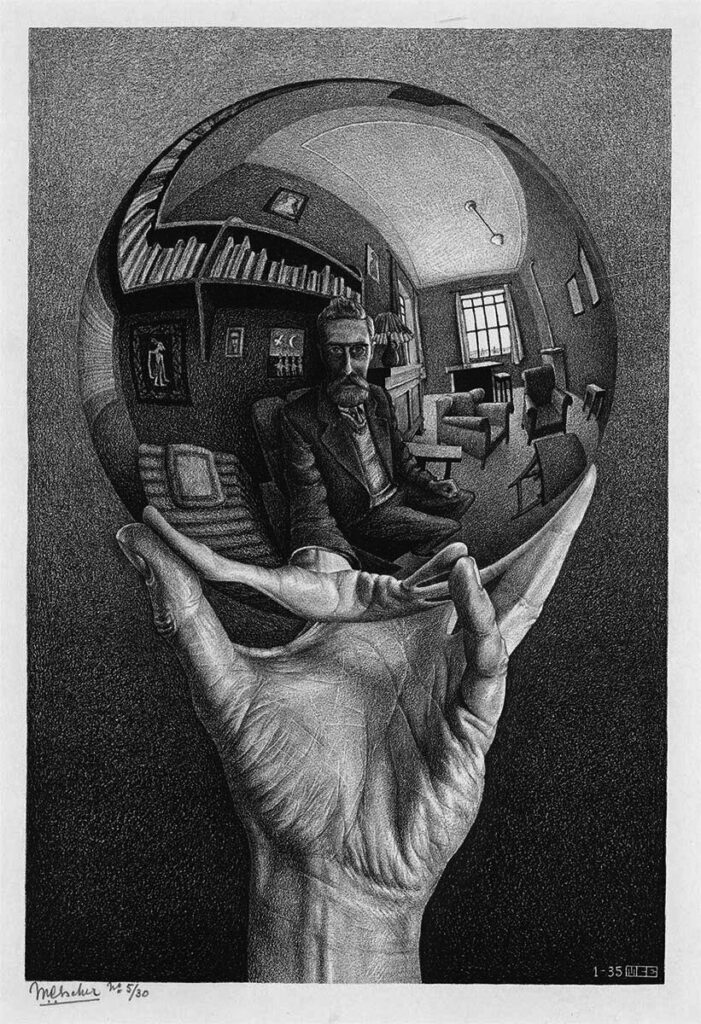
In this self-portrait, Escher distorts reality to accommodate it to the distorted spaces that form his work. As Wikipedia rightly says: "paradoxical spaces that challenge the usual modes of representation".
Simply put, on Instagram reality is not paradoxical; it is, to a large extent, a hyperbolic distillation of what each person considers "perfect".
During the creation of that personal-micro-simulacrum (to call it something), we drag the environment, the landscape, the context along with us... turning it in turn into a hyperreality disconnected from the world.
That environment becomes props, a stage, stripped of its real value.
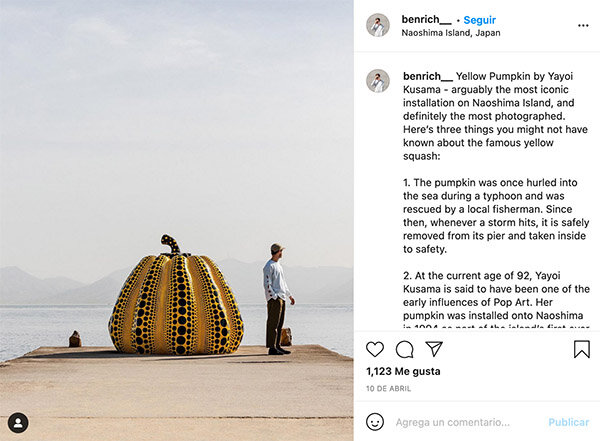
A practical example: when searching for a location on Instagram, for example a beach, it's common to find a result like this:

Ten of the twelve photos are poses and, curiously, the beach doesn't appear in the other two.
It turns out that Mera Beach is simply the background, it's never the protagonist of the search performed.
When you search for a beach on Instagram and find that it's populated by attractive people, with wonderful bodies and perfect tans, you're looking at a utopia where there's no room for failures or imperfections (in this case there's no room for love handles or gothic paleness). There isn't even anyone in the photo except for the protagonist.
Reality is quite different:
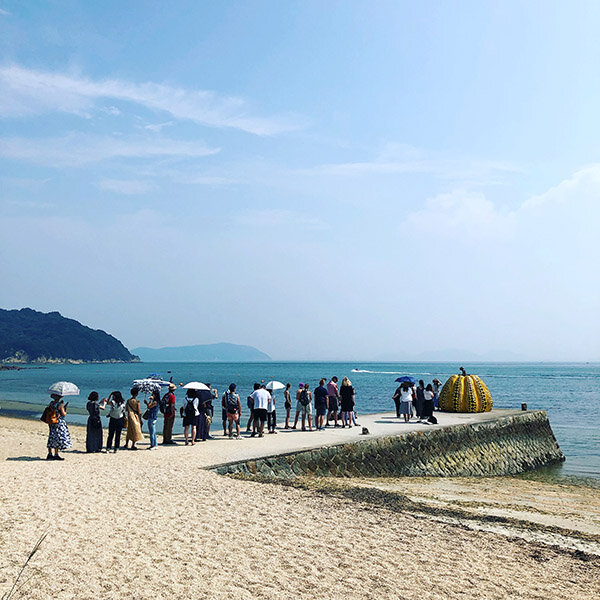
In this hyperreality where everything is staged, from the Gulf War to Instagram profiles, users have become signs of consumer society.
We are then generating aspirational fantasies, mythologizing our personas. Stopping being Clark Kent and putting on Superman's suit.
Only here there's a notable difference: on Instagram we don't see Clark Kent, it's Superman at all times. We don't even have an imperfect reference and all that remains is the illusion that, someday, we'll be able to take a selfie in a dreamlike place just like the one we just saw... and that we forgot 5 minutes after scrolling.
As Umberto Eco says in Apocalittici e integrati:
"The object is the social situation and, at the same time, sign of the same; consequently, it constitutes not only the concrete pursuable goal, but the ritual symbol, the mythical image in which aspirations and desires are condensed. It is the projection of what we wish to be."
It's incredible how the relationship of people on social networks has changed. We've gone from jealously guarding our anonymity to a totally carefree exhibition of our lives.
You just have to think about how in IRC the "nick" and the anonymity it provided were valued, along with the suspicion involved in sending a photo of yourself through the system. On the contrary, now you click and connect Facebook with Tinder, with your real name and a selection of perfect photos. Before you would chat for hours and, maybe, they would send you a photo. Now you see a photo and decide if you'll chat with a swipe.
We take less time to activate our alter ego than Clark Kent putting on Superman's suit in a phone booth.
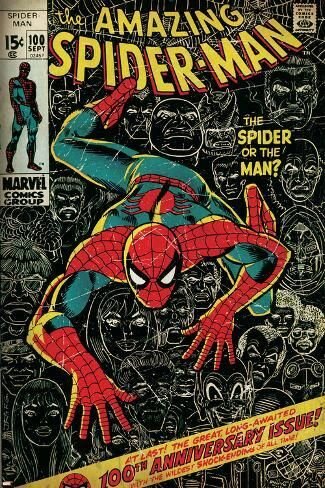
Perhaps the visionary who perfectly understood the human ego in this sense of exhibiting the personal simulacrum was Stan Lee: it's Peter Parker who takes care of taking photos, putting on the Spider-Man suit to star in them.