Post content
Soundtrack: Jay-Z – Empire State of Mind
–
Last week I was watching the Design Systems Course from Instituto Tramontana. Highly recommended, especially regarding the theoretical part and the interviews. The practical part is a delight for Figma fans.
I loved the interview with Wences Sanz, it makes me happy to know that I share a line of thinking with a professional of his caliber.
I've been thinking for many years that, in general, the evolution of the web has killed the adventurous spirit of its beginnings. Systematization and the tacit consensus on how a page should be structured (from navigation to menu design) has prioritized making sure users don't think and buy/register in few steps.
Everything pre-chewed, no surprises. There are no longer sensory experiences and, much less, narratives.
I remember 20 years ago when entering some pages was an absolute surprise and many were really close to a graphic adventure of the time. Or when microsites were micro in size and not in depth.
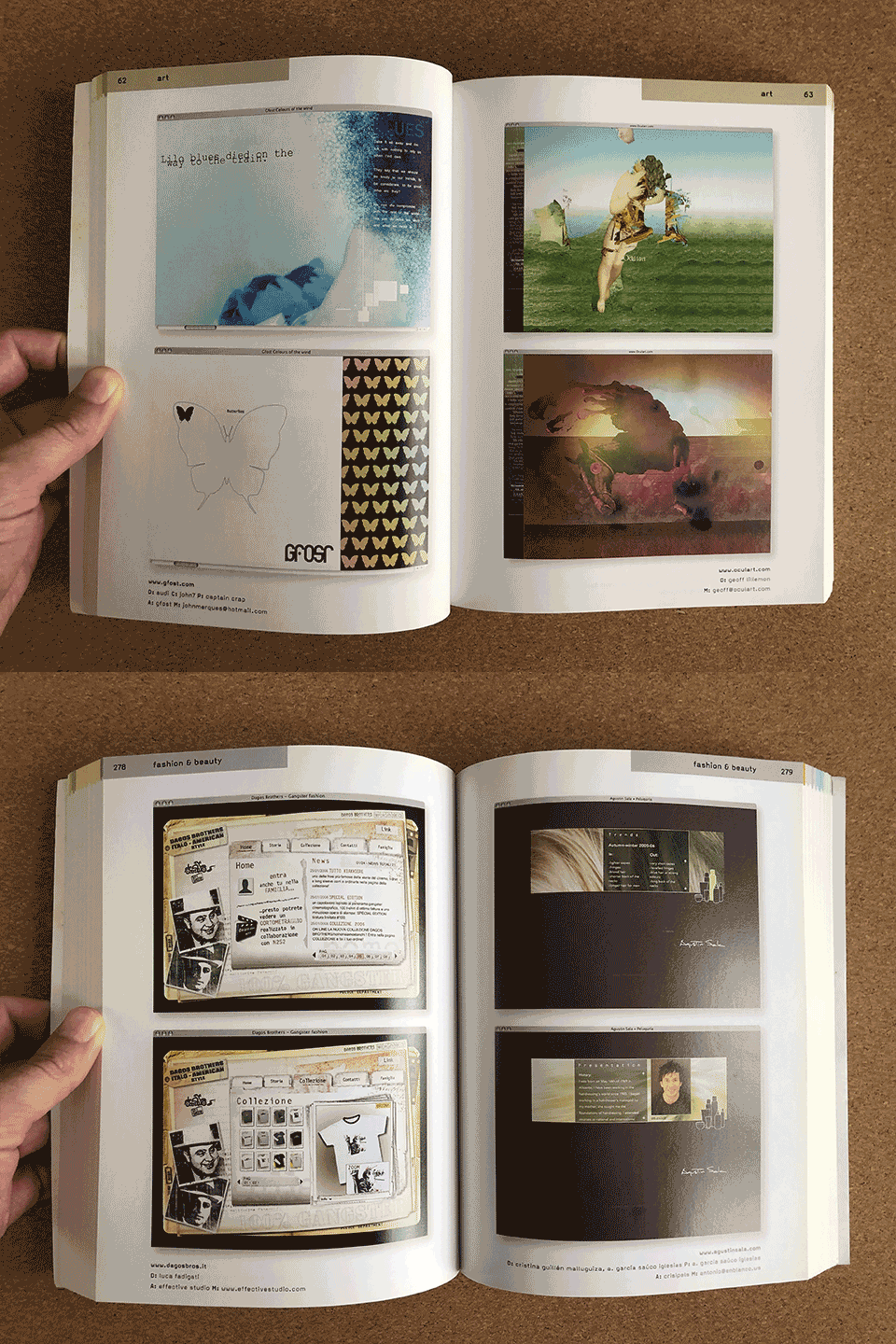
The high GIF compression is for pure nostalgia.
Hours lost on Tool's website, trying to decipher small details that helped you understand the concept behind the band. Today their website is the typical band website: news, tour, store, social media, etc.
There's no surprise anymore, no risks are taken. The only objective is to get clicks so the marketing department can delight in the evolution of conversion ratios.
It's probably because our attention span is developing to its minimum expression: we want everything for now and without thinking. Any extra click frustrates us. Any paragraph longer than a tweet bores us.
Maybe the elegy for the death of Flash (this Flash, not this one) has been too long and we decided to go through mourning in the black suit of web standards.
The systematization of design (and design systems) in digital products is, in part, responsible for this evolution (or involution depending on how you look at it).
Evolution because the profession industrializes and brings the designer closer to the figure of the engineer.
Involution because we're moving away from the creative impulses that make a person want to be a designer in the first place.
Maybe there's a problem on the part of institutes when communicating the design profession to adolescents who will become future professionals.
Or does an 18-year-old future designer imagine themselves applying a design system and basing the choice of a color on the click ratio derived from an A/B test?
Moreover, to what extent is it necessary to have a designer if the color of a button is given by the results of that test?
I don't believe in the dictatorship of data; if that were the case, all call-to-action buttons would end up having the same color.
I believe in reaching agreements in the fight between industry and creativity.
There will be moments for industry: to be efficient, to scale, to obtain greater profitability.
But there also have to be moments for creativity: to develop products with personality, to tell stories.
Will the figure of the Gestaltung Ingenieur that they already preached at the Ulm school end up being consolidated?
All this reminded me of when I attended the first edition of Ableton Loop, specifically Young Guru's conference. When he explains his vision of what a sound engineer is in response to one of the questions the audience asks him (38:51):
"It's about everything being engineered… It's about problem solving, is the essence of engineering… You know, that's engineering to me: someone who's creative and solves problems.
Ok, I have all these resources at my disposal what can I use? And if it doesn't exist, then you create it."